When we gaze up at the starlit expanse of a cinematic galaxy far, far away, we are, in truth, looking down into the rain-soaked mud and mist of feudal Japan. Long before lightsabers hummed in the dark, the sharp ring of the samurai sword echoed through the visionary mind of Japanese auteur Akira Kurosawa. To understand the genesis of modern storytelling—most notably George Lucas’s Star Wars saga—we must journey back to the masterful cinematic tapestries woven by this legendary director. Kurosawa was not merely a filmmaker; he was a philosopher-poet whose sweeping epics of honor, sacrifice, and the bushi (warrior) ethos provided the architectural blueprint for our greatest modern myths.
The Hidden Fortress: Forging a Galaxy from Feudal Dust
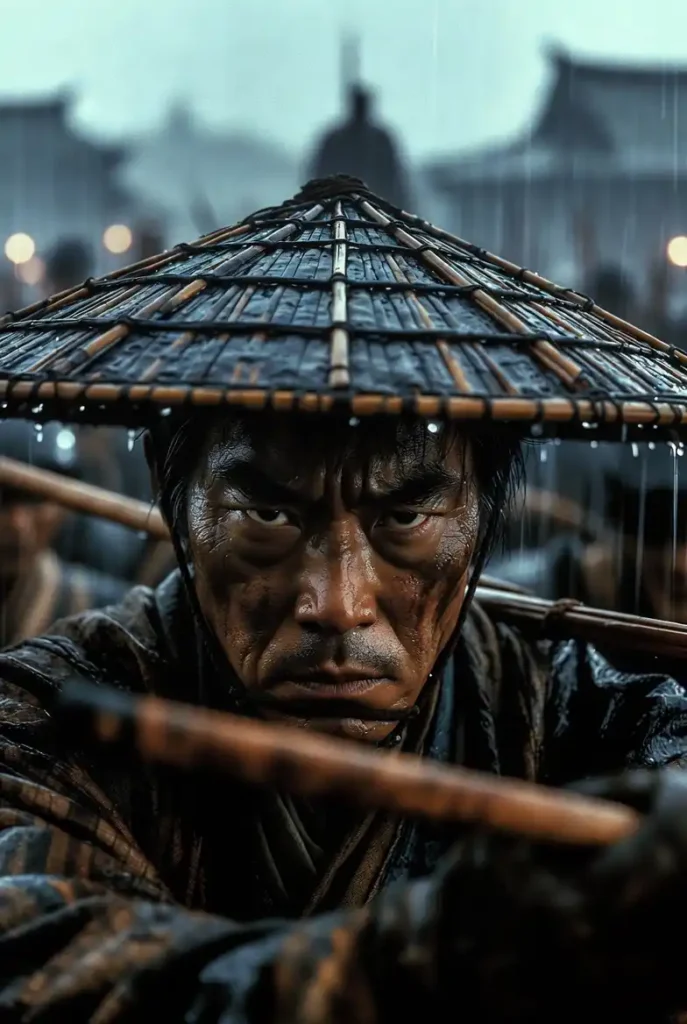
The most profound and direct umbilical cord connecting Kurosawa to the Star Wars universe is his 1958 adventure masterpiece, The Hidden Fortress. When a young George Lucas set out to write his space opera, he was deeply moved by Kurosawa’s decision to tell a grand, sweeping epic from the perspective of its lowliest, most powerless characters. In The Hidden Fortress, these are Tahei and Matashichi, two bumbling, greedy, and constantly bickering peasants caught in the crossfire of warring clans. Lucas transmuted these struggling wanderers into the iconic droids, R2-D2 and C-3PO, utilizing them as the audience’s grounded guides through a terrifying, majestic universe.
Furthermore, the core narrative of Star Wars: A New Hope mirrors Kurosawa’s plot with stunning fidelity: a fiery, defiant princess (Princess Yuki, the precursor to Princess Leia) must be smuggled across treacherous enemy lines to a hidden sanctuary with clan treasure, aided by a hardened, battle-weary general (Rokurota Makabe, the antecedent to Obi-Wan Kenobi). The connection was so strong that Lucas even offered the role of Obi-Wan Kenobi—and later Darth Vader—to Kurosawa’s eternal cinematic muse, the legendary actor Toshiro Mifune, though Mifune ultimately declined out of fear that the sci-fi film might cheapen the image of the samurai.
The Way of the Jedi: Jidaigeki and the Architecture of Myth
Kurosawa’s stylistic and linguistic fingerprints are scattered like stardust across the modern blockbuster. The very word “Jedi” is derived from the Japanese term jidaigeki, which translates to “period drama”—the exact genre of historical samurai films that Kurosawa popularized globally.
The visual aesthetics of the Star Wars universe also owe a tremendous debt to samurai material culture. The terrifying visage of Darth Vader, specifically his imposing black helmet, is a direct cinematic descendant of the kabuto, the armored masks worn by Japanese warlords to strike fear into the hearts of their enemies.
Even the transitional grammar of Star Wars was inherited directly from Kurosawa. The distinctive “wipe” transitions—where a visible line sweeps across the screen to reveal the next scene—were a signature cinematic punctuation used by Kurosawa to simulate the turning of a page in a vast, epic novel. Lucas adopted this technique to give his space saga a serial, mythic pacing that paid homage to Kurosawa’s fluid storytelling.
Echoes of the Ronin: Han Solo and the Wandering Warrior
Kurosawa’s deconstruction of the flawless, chivalric hero left an indelible mark on modern character archetypes. Through films like Yojimbo (1961) and Sanjuro (1962), Kurosawa and Mifune birthed the archetype of the cynical, masterless ronin—a wandering warrior who scoffs at authority and operates for personal gain, yet ultimately harbors a deeply buried, unwavering moral compass.
This is the spiritual ancestor of Han Solo. Screenwriter Lawrence Kasdan, who penned The Empire Strikes Back and The Force Awakens, revered Kurosawa as “the Shakespeare of movies” and sought to infuse the Star Wars mythos with this same tension between selfish desire and noble duty. Solo’s transformation from a rogue smuggler who only cares for reward money into a selfless leader of the Rebellion mirrors the philosophical clash between ninjo (human feeling) and giri (duty) that defines the conflicted samurai.
Even the ancient Jedi Master Yoda finds his roots in the soil of Kurosawa’s cinema. Kasdan based Yoda’s immense wisdom, patience, and deliberate, contemplative syntax on Kanbei Shimada, the stoic leader from Seven Samurai who sees the overarching tapestry of conflict. Visually and spiritually, Yoda also echoes the titular character of Kurosawa’s Dersu Uzala—a wizened, solitary figure living in profound harmony with nature, teaching headstrong youths the necessity of humility before the vastness of the universe.
The Rashomon Effect: Subjective Truth in the Modern Blockbuster
The thematic resonance of Kurosawa extends into the latest chapters of the saga. In his 1950 triumph Rashomon, Kurosawa shattered narrative conventions by presenting a single violent event from four conflicting perspectives, demonstrating that absolute truth is an illusion clouded by human ego, memory, and shame.
This cinematic innovation, now universally known as the Rashomon effect, was brilliantly deployed by director Rian Johnson in Star Wars: The Last Jedi (2017). To depict the tragic falling out between Luke Skywalker and his nephew Ben Solo (Kylo Ren), the film shows the fateful night through differing, unreliable viewpoints, honoring Kurosawa’s exploration of subjective truth. Furthermore, The Last Jedi features the Knights of Ren standing in a driving rainstorm—a deliberate visual homage to the doomed, majestic warriors of Seven Samurai—and utilizes the stark crimson and shadow color palette of Kurosawa’s late epic Ran for its climactic throne room battle.
A Legacy Beyond the Stars
Beyond Star Wars, the DNA of Kurosawa’s samurai breathes life into countless other modern tapestries. The concept of assembling a disparate team of rogues for a noble suicide mission—pioneered in Seven Samurai (1954)—became the skeletal structure for everything from The Magnificent Seven to Pixar’s A Bug’s Life, and even the sprawling superhero team-up epics of today. The trope of a lone, heavily armored warrior protecting a vulnerable child, a motif seen in The Mandalorian, draws directly from the ronin films of the 1960s and the Lone Wolf and Cub framework.
Ultimately, Akira Kurosawa did not merely make movies; he forged a new mythology. By taking the rigid bushidō code of his ancestors and exposing its beating, bleeding human heart, he gifted modern storytellers the tools to build their own empires, ensuring that the way of the warrior will continue to echo across our screens for generations to come.
The Forges of the Modern Warrior: Master Artisans and Armorers
To walk the path of the bushi is to appreciate the profound weight of iron, leather, and silk. For those seeking to wrap themselves in the historical legacy of the samurai, several masterful workshops and digital armories not only craft these magnificent panoplies but deeply chronicle the evolution of the warrior class.
Iron Mountain Armory (samurai-armor.com / ironmountainarmory.com)
This armory is a revelation for both the martial artist and the historian. They masterfully detail the genealogy of yoroi (armor)—from the imposing, boxy silhouettes of the Heian mounted archers to the highly efficient, bullet-deflecting tōsei-gusoku (“modern equipment”) of the Warring States period. Beyond their rich historical guides, they handcraft fully functional, customizable armor sets, alongside authentic traditional garments like the hakama and the cross-over hakama-shita.
Marutake Armor Factory (marutake-yoroi.myshopify.com/en)
Located in Kagoshima Prefecture, Marutake is the undisputed titan of Japanese armor reproduction, commanding roughly ninety percent of the domestic market for replica armor used in cinema and historical festivals. Their online platform offers beautiful insights into the meticulous, traditional methods required to wear and maintain the armor, while selling breathtaking replicas of legendary warlords like Oda Nobunaga and Takeda Shingen.
Pacific Armory (pacificarmory.com)
For the uninitiated stepping into the world of Japanese metallurgy, Pacific Armory serves as a profound educational gateway. They beautifully demystify the complex terminology of the samurai panoply—breaking down the spiritual and practical purposes of the kabuto (helmet), the terrifying menpō (face mask), and the dō (cuirass). In tandem with this education, they supply handcrafted, authentic-style armor sets built for display, reenactment, and martial practice.
Sanctuaries of Antiquity: Museums and High-End Dealers
For the dedicated collector seeking to possess a genuine artifact forged centuries ago, these institutions bridge the gap between historical preservation and global commerce.
Samurai Museum Shop (samuraimuseum.jp/shop/)
Born from the Samurai Museum in Tokyo’s bustling Shinjuku district, this shop acts as an educational and cultural nexus. They publish detailed guides on how to legally acquire and care for authentic Japanese swords, while offering an astonishing inventory. Here, one can acquire museum-grade antique katanas, intricately carved tsuba (handguards), and magnificent Marutake replica armors.
Samurai Store (samuraistore.com)
This esteemed gallery operates with a deep reverence for the “ceremonial prestige aesthetic” of the Edo period. They offer a staggering array of 100% handcrafted replica armors, but their true allure lies in their curation of highly certified, antique yoroi and kabuto from the 16th to 19th centuries.
Giuseppe Piva Japanese Art (giuseppepiva.com)
Operating at the pinnacle of art dealing, this gallery offers deeply evocative, scholarly articles on the fundamental anatomy and construction of the samurai helmet. For the affluent collector, they offer extraordinarily rare, museum-quality antique armors and helmets, such as the exquisite Suji-bachi and Mōsunari kabuto.
The Path of the Martial Artist: Armaments and Traditional Garb
To understand the philosopher-poet heart of the samurai, one must look at the tools and garments that defined their daily, disciplined existence.
Tozando (tozandoshop.com / japanesesword.net)
Rooted in Kyoto, Tozando is an indispensable resource for the modern budō practitioner. Their blog is a treasure trove of historical research, exploring the daily routines, spiritual philosophies, and economic struggles of the Edo-period warrior. Alongside this profound storytelling, they sell an exhaustive array of martial arts equipment, newly forged katanas (shinsakuto), and traditional yoroi armor.
TrueKatana (truekatana.com)
This platform weaves evocative tales of historical samurai elegance, offering deep walkthroughs of the evolution of civil and martial clothing—from the restrictive kamishimo of the Edo courts to the breathable hitoe worn beneath armor. They cater to enthusiasts by selling a vast array of katanas, ninja swords, and complete Japanese samurai armor sets.
Katana Sword / Katana US (katana-sword.com / katana-us.com)
Delving into the invisible architecture of the warrior’s mind, their articles explore the intimate, spiritual relationship between the samurai, the sword as the “soul of the warrior,” and the overarching ethos of bushidō. Their storefront provides an extensive selection of custom blades, display swords, and samurai armor.
The Global Armories: Merchants of the Blade and Scale
The aesthetic of the samurai has transcended the borders of Japan, maintained by passionate global merchants who ensure the legacy of the bushi continues to echo around the world.
Kult of Athena (kultofathena.com)
As one of the largest global arms dealers, they chronicle the violent, beautiful evolution of the katana and the warriors who wielded it. Their vast inventory includes everything from raw blades to complete suits of samurai armor.
Suigenkyo Online Store (suigenkyo.store)
A beautiful digital space dedicated to preserving the history of Japanese craftsmanship. They offer deep cultural context and interviews with artisans, while serving as a primary vendor for the masterfully crafted Marutake samurai armor and exquisite civilian crafts.
Guardians Vault Australia (guardiansvaultaustralia.com)
This outfitter provides the physical foundation of the warrior’s attire. They offer traditional garments like the flowing hitatare kamishimo—the “upper and lower” clothing set—alongside samurai armor and weaponry.
Battle-Merchant (battlemerchant.com)
A sprawling European hub for historical reenactors. Their blog discusses the profound connection between Zen Buddhism, the bushidō code, and the art of swordsmanship. They supply a diverse range of armors, katanas, and maintenance kits.
Espadas y Más (espadasymas.com)
This Spanish marketplace explores the melancholic legacy of the rōnin (masterless samurai) and the profound bond of honor forged in steel. They cater to the European market with an array of anime-inspired weapons, historical Japanese helmets, and martial armor.
Wyrmwick (wyrmwick.com)
Though primarily focused on European and fantasy aesthetics, this UK-based armory provides high-quality polyurethane armor replicas for historical reenactment, film, and theater, offering an accessible entry point for those wishing to don the heavy mantle of the past.
- The primary weapon of the samuraiThere was no single primary weapon across their entire history; rather, their favored instrument of war evolved in harmony with the changing tides of battle and society. The wind howls across the plains of feudal Japan, carrying the scent of pine and impending conflict. When we picture the noble samurai standing amidst this tempest, our… Read more: The primary weapon of the samurai
- Kurosawa’s films influence modern stories like Star WarsWhen we gaze up at the starlit expanse of a cinematic galaxy far, far away, we are, in truth, looking down into the rain-soaked mud and mist of feudal Japan. Long before lightsabers hummed in the dark, the sharp ring of the samurai sword echoed through the visionary mind of Japanese auteur Akira Kurosawa. To understand the… Read more: Kurosawa’s films influence modern stories like Star Wars
- Mono no AwareIt fit not as a contradiction, but as the very heart of the samurai soul. Mono no aware — that exquisite, aching awareness of how beautiful things are precisely because they are fleeting — was never a soft indulgence for the bushi. It was the emotional and philosophical steel that made their hardness meaningful. The… Read more: Mono no Aware
- The Guardian of the Inner Sanctum: The Heavy Mantle of the Samurai Women (Oku-sama)Samurai women (Oku-sama) of the bushi (warrior class) were explicitly expected to defend their homes, estates, and castles as a fundamental duty rooted in loyalty to family, clan honor, and the samurai ethos. While men fought on distant battlefields, wives, mothers, and daughters served as the last line of protection for the household—especially during the… Read more: The Guardian of the Inner Sanctum: The Heavy Mantle of the Samurai Women (Oku-sama)
- The magnificent Owari Tokugawa helmet (kabuto) and menpō (face guard)To stand before the hereditary treasures of the Owari Tokugawa clan is to be confronted by the breathtaking weight of power, frozen in iron, lacquer, and silver. Housed within the hushed galleries of the Tokugawa Art Museum in Nagoya—a sanctuary preserving the unbroken lineage of the most senior branch of the Tokugawa shogunate—these artifacts tell… Read more: The magnificent Owari Tokugawa helmet (kabuto) and menpō (face guard)