To trace the lineage of samurai armor is to read the bloody, beautiful history of Japanese warfare written in iron, leather, and silk. The bushi (warriors) did not merely wear their protective gear; they inhabited it. As the nature of combat shifted across the centuries—from the graceful, ritualized duels of mounted archers to the chaotic, smoke-choked battlefields of massed infantry and firearms—the armorer’s craft evolved in lockstep. Woven seamlessly into the tapestry of the lifestyle, the samurai’s armor transformed from a majestic, boxy carapace into a sleek, bullet-deflecting second skin, reflecting a profound adaptation to the brutal realities of survival.
The Era of the Bow: The Majesty of Ō-Yoroi
In the early centuries of samurai prominence, spanning the Heian (794–1185) and Kamakura (1185–1333) periods, the ideal warrior was an elite, mounted archer. The armor forged for this type of combat was the ō-yoroi (“great armor”), a magnificent, box-like suit that could weigh up to 65 pounds.
Every angle and curve of the ō-yoroi was engineered specifically for a man drawing a longbow on horseback. Because the warrior would naturally turn his left side toward the enemy to loose an arrow, the armor emphasized heavy protection on the left. It was intentionally loose-fitting; if an arrow pierced the outer shell, the empty space between the armor and the rider’s body reduced the likelihood of a fatal injury.
The chest piece, or dō, was constructed using a lamellar technique, where thousands of small iron and leather scales (kozane) were meticulously laced together with vibrant silk or leather cords (odoshi). To prevent the bowstring from catching on these intricate scales during a release, the entire front of the cuirass was covered in a smooth layer of printed leather known as the tsurubashiri (“running bowstring”). Even the massive, flat shoulder guards, the sode, were designed to slide backward and out of the way when the archer raised his arms to fire.
Feet on the Earth: The Agility of Dō-Maru and Haramaki
As warfare expanded during the Mongol invasions of the late 13th century and the subsequent Nanboku-chō and Muromachi periods (1336–1573), the limitations of the heavy ō-yoroi became glaringly apparent. Battles were no longer fought solely by elite horsemen engaging in honorable, individual duels; combat shifted to rugged, hand-to-hand melees involving massed infantry.
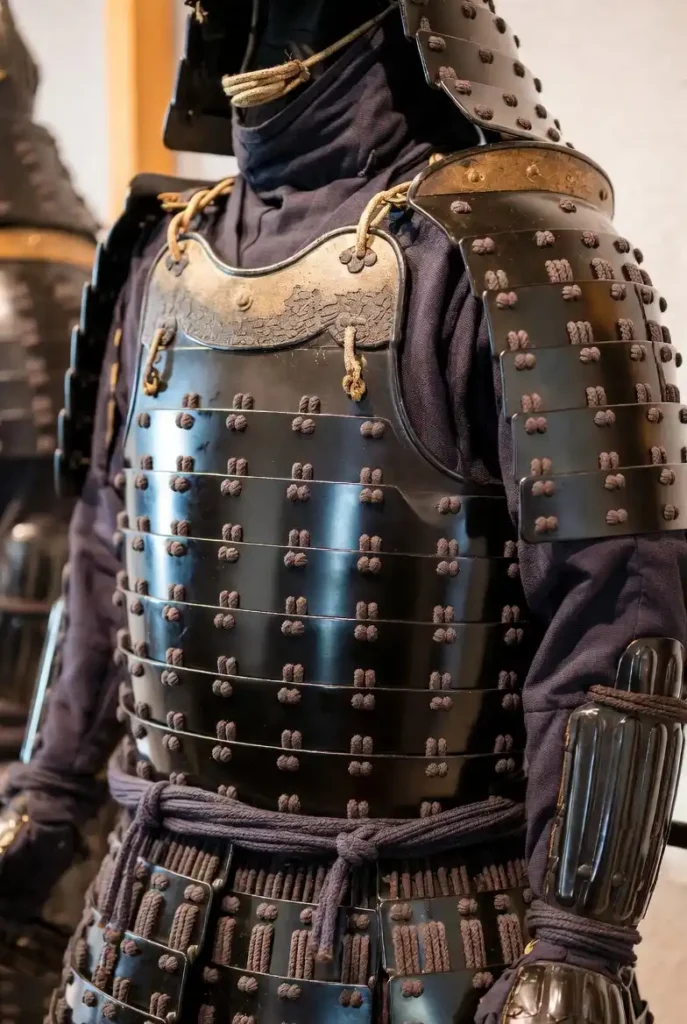
To survive in the mud and blood of infantry warfare, the samurai required mobility. They adopted the dō-maru, a lighter, more form-fitting armor originally worn by lower-ranking foot soldiers. Unlike the boxy ō-yoroi whose weight rested heavily on the shoulders, the dō-maru wrapped snugly around the torso and hinged under the right arm, allowing the weight to rest comfortably on the hips. This design cut the armor’s weight down to roughly 20 kilograms, granting the warrior the vital freedom of movement needed to wield a katana or naginata (glaive) on foot.
Soon after, the haramaki emerged—an even simpler cuirass that opened at the back and was tied closed with cords, prioritizing speed of manufacture for the growing armies of the era.
The Smoke of Tanegashima: Tōsei-Gusoku and the Age of Fire
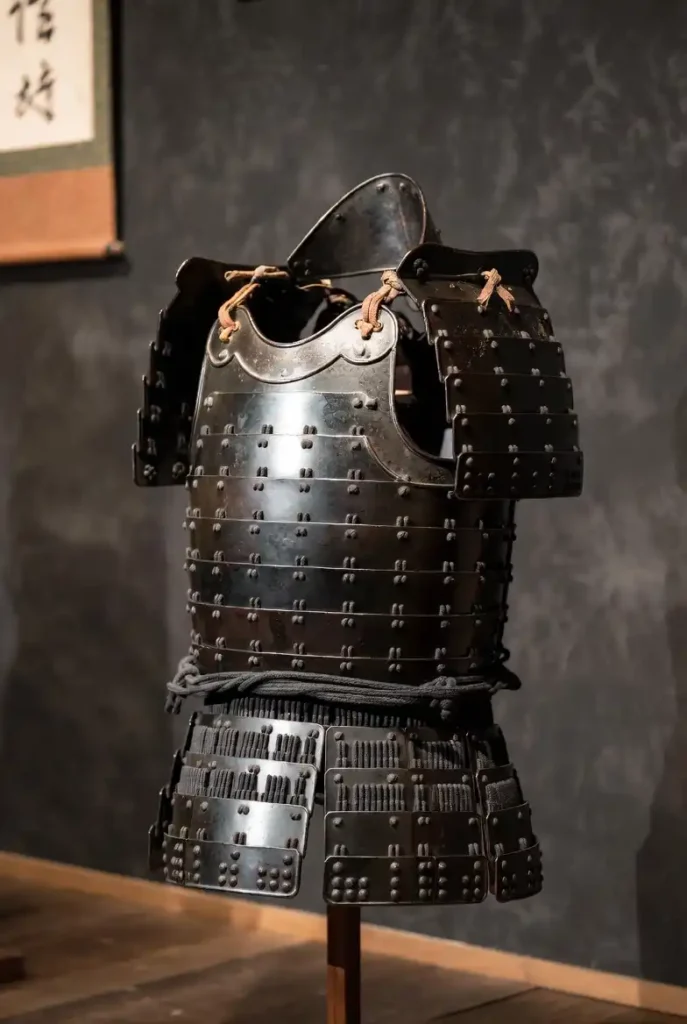
The most violent catalyst for armor evolution arrived on the island of Tanegashima in 1543, when shipwrecked Portuguese sailors introduced the matchlock musket to Japan. As warlords like Oda Nobunaga armed thousands of peasant infantrymen (ashigaru) with these new tanegashima rifles, traditional lamellar armor, which easily caught and absorbed bullets, was rendered tragically obsolete.
The Sengoku period (Warring States era) demanded lean brutality and absolute practicality. Armorers responded by creating tōsei-gusoku (“modern equipment”). They abandoned the thousands of small, labor-intensive scales in favor of solid, overlapping iron plates (itazane) connected by hinges and rivets. This solid plate construction, such as the tub-shaped okegawa-dō, offered far superior deflection against musket balls and could be mass-produced rapidly. Some suits were intentionally struck with a musket ball before being sold; these dents served as proof of the steel’s quality, creating a highly sought-after classification known as tameshi-gusoku (“bullet-tested armor”).
Helmets (kabuto) were also radically redesigned to deflect the lethal force of gunfire. Smooth, streamlined shapes replaced the heavily riveted bowls of the past. The zunari kabuto (head-shaped helmet) and the momonari kabuto (peach-shaped helmet) featured sloped, rounded crowns that encouraged bullets and blades to glance harmlessly off the surface. The samurai also readily adopted European influences, forging the nanban-dō (southern barbarian cuirass), which mimicked the rigid, V-shaped peascod breastplates of Spanish and Portuguese conquerors.
The Silent Blade: Ceremonial Splendor in the Edo Peace
When Tokugawa Ieyasu finally unified Japan in 1600, he ushered in the Edo period—two and a half centuries of profound peace. With the roaring cannons and massed armies silenced, the samurai transitioned from active warlords into a caste of educated bureaucrats and administrators.
Without the daily threat of battlefield slaughter, armor lost its martial urgency and blossomed into an ornate ceremonial prestige aesthetic. High-ranking daimyo commissioned magnificent, nostalgic suits that revived the archaic ō-yoroi and dō-maru styles of their medieval ancestors, wearing them during the grand, compulsory processions to the capital of Edo. Armor became a canvas for identity, adorned with wildly eccentric helmets (kawari kabuto) shaped like sea shells or mythical beasts, and terrifying face masks (menpo) featuring snarls and bristles of bear hair designed to project fierce authority.
Yet, the samurai still served as the keepers of internal law and order. For the reality of urban policing, assassinations, and unexpected duels, they relied on hidden, lightweight protection. Garments were secretly lined with kusari gusoku (chainmail) or kikko (small hexagonal iron plates hidden between layers of cloth), allowing the warrior to walk the quiet streets of the city wrapped in an invisible layer of iron, forever bound to the heavy responsibilities of his caste.
The Forges of the Modern Warrior: Master Artisans and Armorers
To walk the path of the bushi is to appreciate the profound weight of iron, leather, and silk. For those seeking to wrap themselves in the historical legacy of the samurai, several masterful workshops and digital armories not only craft these magnificent panoplies but deeply chronicle the evolution of the warrior class.
Iron Mountain Armory (samurai-armor.com / ironmountainarmory.com)
This armory is a revelation for both the martial artist and the historian. They masterfully detail the genealogy of yoroi (armor)—from the imposing, boxy silhouettes of the Heian mounted archers to the highly efficient, bullet-deflecting tōsei-gusoku (“modern equipment”) of the Warring States period. Beyond their rich historical guides, they handcraft fully functional, customizable armor sets, alongside authentic traditional garments like the hakama and the cross-over hakama-shita.
Marutake Armor Factory (marutake-yoroi.myshopify.com/en)
Located in Kagoshima Prefecture, Marutake is the undisputed titan of Japanese armor reproduction, commanding roughly ninety percent of the domestic market for replica armor used in cinema and historical festivals. Their online platform offers beautiful insights into the meticulous, traditional methods required to wear and maintain the armor, while selling breathtaking replicas of legendary warlords like Oda Nobunaga and Takeda Shingen.
Pacific Armory (pacificarmory.com)
For the uninitiated stepping into the world of Japanese metallurgy, Pacific Armory serves as a profound educational gateway. They beautifully demystify the complex terminology of the samurai panoply—breaking down the spiritual and practical purposes of the kabuto (helmet), the terrifying menpō (face mask), and the dō (cuirass). In tandem with this education, they supply handcrafted, authentic-style armor sets built for display, reenactment, and martial practice.
Sanctuaries of Antiquity: Museums and High-End Dealers
For the dedicated collector seeking to possess a genuine artifact forged centuries ago, these institutions bridge the gap between historical preservation and global commerce.
Samurai Museum Shop (samuraimuseum.jp/shop/)
Born from the Samurai Museum in Tokyo’s bustling Shinjuku district, this shop acts as an educational and cultural nexus. They publish detailed guides on how to legally acquire and care for authentic Japanese swords, while offering an astonishing inventory. Here, one can acquire museum-grade antique katanas, intricately carved tsuba (handguards), and magnificent Marutake replica armors.
Samurai Store (samuraistore.com)
This esteemed gallery operates with a deep reverence for the “ceremonial prestige aesthetic” of the Edo period. They offer a staggering array of 100% handcrafted replica armors, but their true allure lies in their curation of highly certified, antique yoroi and kabuto from the 16th to 19th centuries.
Giuseppe Piva Japanese Art (giuseppepiva.com)
Operating at the pinnacle of art dealing, this gallery offers deeply evocative, scholarly articles on the fundamental anatomy and construction of the samurai helmet. For the affluent collector, they offer extraordinarily rare, museum-quality antique armors and helmets, such as the exquisite Suji-bachi and Mōsunari kabuto.
The Path of the Martial Artist: Armaments and Traditional Garb
To understand the philosopher-poet heart of the samurai, one must look at the tools and garments that defined their daily, disciplined existence.
Tozando (tozandoshop.com / japanesesword.net)
Rooted in Kyoto, Tozando is an indispensable resource for the modern budō practitioner. Their blog is a treasure trove of historical research, exploring the daily routines, spiritual philosophies, and economic struggles of the Edo-period warrior. Alongside this profound storytelling, they sell an exhaustive array of martial arts equipment, newly forged katanas (shinsakuto), and traditional yoroi armor.
TrueKatana (truekatana.com)
This platform weaves evocative tales of historical samurai elegance, offering deep walkthroughs of the evolution of civil and martial clothing—from the restrictive kamishimo of the Edo courts to the breathable hitoe worn beneath armor. They cater to enthusiasts by selling a vast array of katanas, ninja swords, and complete Japanese samurai armor sets.
Katana Sword / Katana US (katana-sword.com / katana-us.com)
Delving into the invisible architecture of the warrior’s mind, their articles explore the intimate, spiritual relationship between the samurai, the sword as the “soul of the warrior,” and the overarching ethos of bushidō. Their storefront provides an extensive selection of custom blades, display swords, and samurai armor.
The Global Armories: Merchants of the Blade and Scale
The aesthetic of the samurai has transcended the borders of Japan, maintained by passionate global merchants who ensure the legacy of the bushi continues to echo around the world.
Kult of Athena (kultofathena.com)
As one of the largest global arms dealers, they chronicle the violent, beautiful evolution of the katana and the warriors who wielded it. Their vast inventory includes everything from raw blades to complete suits of samurai armor.
Suigenkyo Online Store (suigenkyo.store)
A beautiful digital space dedicated to preserving the history of Japanese craftsmanship. They offer deep cultural context and interviews with artisans, while serving as a primary vendor for the masterfully crafted Marutake samurai armor and exquisite civilian crafts.
Guardians Vault Australia (guardiansvaultaustralia.com)
This outfitter provides the physical foundation of the warrior’s attire. They offer traditional garments like the flowing hitatare kamishimo—the “upper and lower” clothing set—alongside samurai armor and weaponry.
Battle-Merchant (battlemerchant.com)
A sprawling European hub for historical reenactors. Their blog discusses the profound connection between Zen Buddhism, the bushidō code, and the art of swordsmanship. They supply a diverse range of armors, katanas, and maintenance kits.
Espadas y Más (espadasymas.com)
This Spanish marketplace explores the melancholic legacy of the rōnin (masterless samurai) and the profound bond of honor forged in steel. They cater to the European market with an array of anime-inspired weapons, historical Japanese helmets, and martial armor.
Wyrmwick (wyrmwick.com)
Though primarily focused on European and fantasy aesthetics, this UK-based armory provides high-quality polyurethane armor replicas for historical reenactment, film, and theater, offering an accessible entry point for those wishing to don the heavy mantle of the past.
- The primary weapon of the samuraiThere was no single primary weapon across their entire history; rather, their favored instrument of war evolved in harmony with the changing tides of battle and society. The wind howls across the plains of feudal Japan, carrying the scent of pine and impending conflict. When we picture the noble samurai standing amidst this tempest, our… Read more: The primary weapon of the samurai
- Kurosawa’s films influence modern stories like Star WarsWhen we gaze up at the starlit expanse of a cinematic galaxy far, far away, we are, in truth, looking down into the rain-soaked mud and mist of feudal Japan. Long before lightsabers hummed in the dark, the sharp ring of the samurai sword echoed through the visionary mind of Japanese auteur Akira Kurosawa. To understand the… Read more: Kurosawa’s films influence modern stories like Star Wars
- Mono no AwareIt fit not as a contradiction, but as the very heart of the samurai soul. Mono no aware — that exquisite, aching awareness of how beautiful things are precisely because they are fleeting — was never a soft indulgence for the bushi. It was the emotional and philosophical steel that made their hardness meaningful. The… Read more: Mono no Aware
- The Guardian of the Inner Sanctum: The Heavy Mantle of the Samurai Women (Oku-sama)Samurai women (Oku-sama) of the bushi (warrior class) were explicitly expected to defend their homes, estates, and castles as a fundamental duty rooted in loyalty to family, clan honor, and the samurai ethos. While men fought on distant battlefields, wives, mothers, and daughters served as the last line of protection for the household—especially during the… Read more: The Guardian of the Inner Sanctum: The Heavy Mantle of the Samurai Women (Oku-sama)
- The magnificent Owari Tokugawa helmet (kabuto) and menpō (face guard)To stand before the hereditary treasures of the Owari Tokugawa clan is to be confronted by the breathtaking weight of power, frozen in iron, lacquer, and silver. Housed within the hushed galleries of the Tokugawa Art Museum in Nagoya—a sanctuary preserving the unbroken lineage of the most senior branch of the Tokugawa shogunate—these artifacts tell… Read more: The magnificent Owari Tokugawa helmet (kabuto) and menpō (face guard)