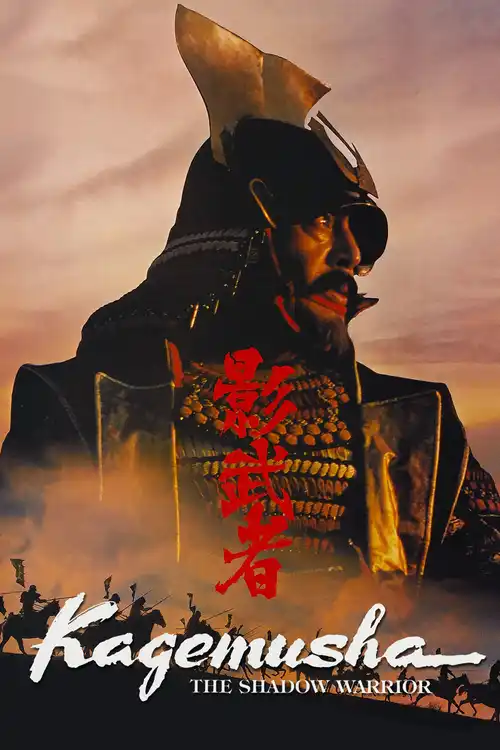
Kagemusha (Shadow Warrior, 1980), Akira Kurosawa’s epic jidaigeki masterpiece, ranks among the most historically accurate and atmospherically evocative depictions of samurai life in cinema. Set in the late Sengoku period (specifically 1571–1575), it dramatizes the final years of the powerful Takeda clan under daimyō Takeda Shingen (1521–1573) and its catastrophic defeat at the Battle of Nagashino. While the central “kagemusha” plot device—a lowly thief impersonating the dying warlord—is fictional, Kurosawa grounded the film in rigorous historical research, creating a work that feels profoundly authentic in its visuals, rituals, politics, and tragic spirit.
The Canvas of War: Kurosawa’s Masterful Recreation of the Sengoku Era
To watch Akira Kurosawa’s 1980 masterpiece Kagemusha (The Shadow Warrior) is to step directly into the churning, blood-soaked machinery of the late Sengoku (Warring States) period. Rather than relying on the romanticized myths of individual, invincible swordsmen that dominate much of pop culture, the film is revered by Japanese historians for its breathtaking, meticulous historical authenticity. It does not merely tell a story; it excavates the psychological and martial reality of 16th-century Japan.
The narrative centers on a lowly, condemned thief who is spared execution to serve as a kagemusha—a political decoy—for the dying daimyō (feudal lord), the legendary Takeda Shingen. Through the terrified, bewildered eyes of this peasant impostor, Kurosawa perfectly evokes the true, crushing weight of the samurai lifestyle.
The Architecture of Illusion: Castle Life and the Cult of the Daimyō
One of the greatest historical triumphs of Kagemusha is its depiction of the cult of personality that sustained samurai clans. In the chaotic void of the Sengoku era, a clan’s survival rested entirely on the perceived invincibility of its lord. When Shingen dies, his generals understand that the mere rumor of his passing will invite utter annihilation from rival warlords like Oda Nobunaga and Tokugawa Ieyasu.
The film brilliantly captures the claustrophobic paranoia of castle life and the heavy burden of leadership. The impostor must learn to mimic not just the physical movements of the warlord, but his heavy, immovable aura. Actor Tatsuya Nakadai masterfully shifts between the stately, languid repose of the true daimyō and the awkward bumbling of the thief. Through this agonizing performance, we witness how the samurai system required absolute, unquestioning submission to the symbol of the lord, transforming a man into a living monument.
Iron and Smoke: The Accurate Mechanics of 16th-Century Warfare
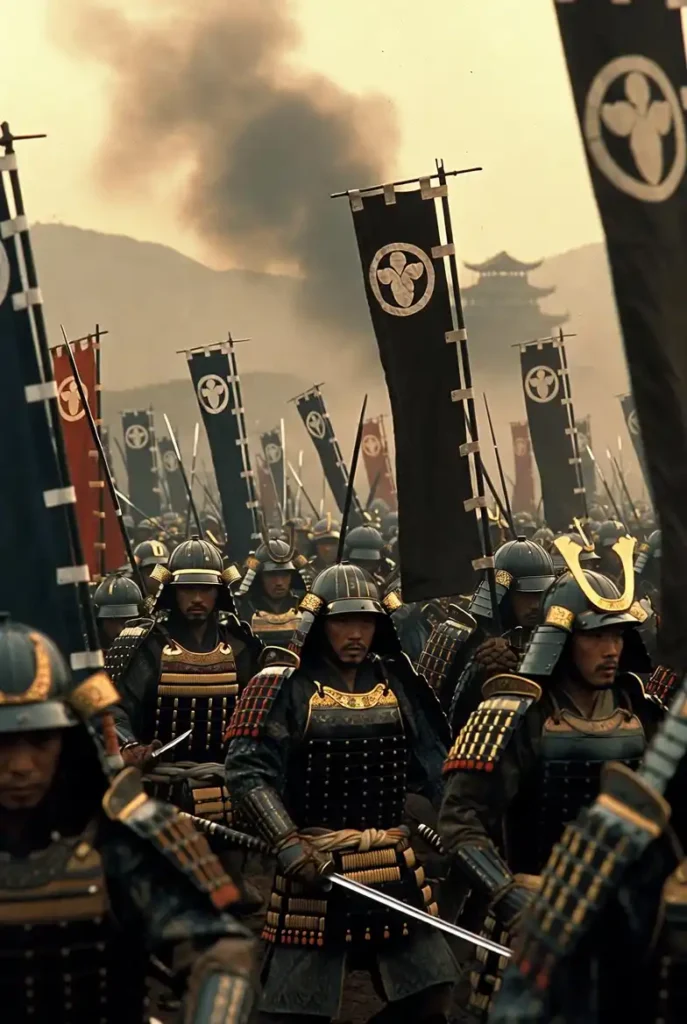
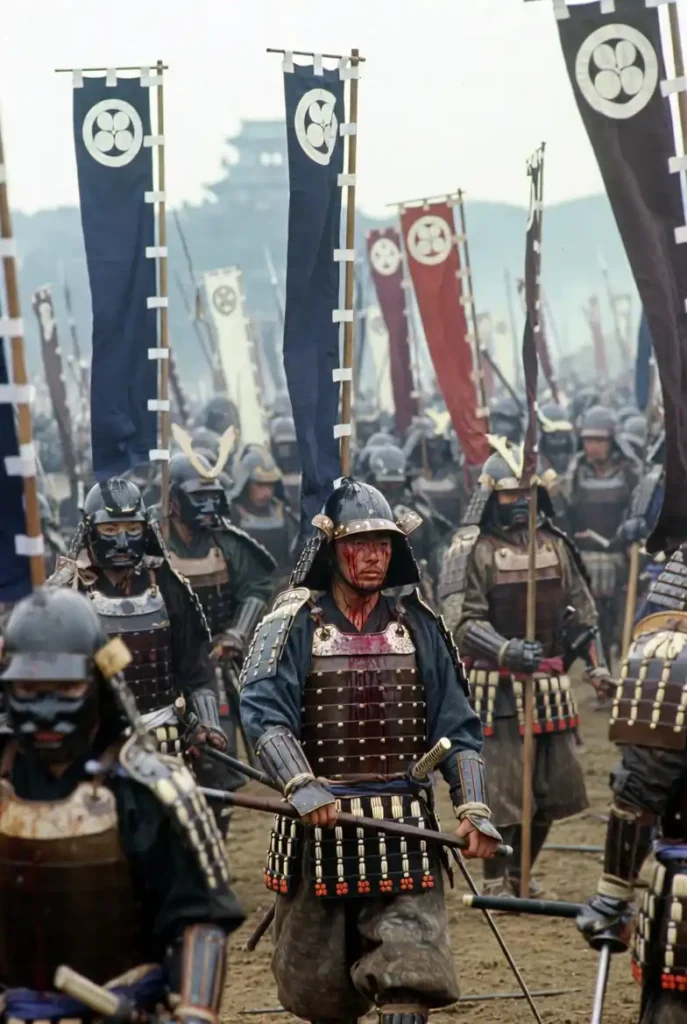
Kurosawa’s obsession with material culture ensures that the film operates almost as a visual documentary of feudal military tactics. The director insisted on an astonishing level of historical fidelity regarding costuming, armor, and the vast, sweeping troop formations that defined the era. We see armies maneuver not as chaotic brawlers, but as highly disciplined, color-coded divisions marching under their clan’s fluttering sashimono (back banners) and imposing uma-jirushi (commander’s standards).
This historical accuracy reaches its devastating crescendo in the film’s climax, which recreates the pivotal 1575 Battle of Nagashino. Here, Kurosawa unflinchingly portrays a watershed moment in Japanese history: the transition from the old, noble ways of war to the mechanized slaughter of the modern age. The film depicts the tragic, futile charge of the elite Takeda cavalry against Oda Nobunaga’s entrenched lines of peasant ashigaru (foot soldiers) armed with tanegashima (matchlock muskets). It is a terrifying, evocative sequence that mourns the obsolescence of traditional samurai martial prowess in the face of gunpowder.
The Expendable Soul: Rank Versus Human Feeling
Beyond the clash of armies, Kagemusha is deeply evocative of the philosophical and emotional realities of the samurai caste system. As the thief spends time as the shadow warrior, he begins to genuinely absorb the dead lord’s spirit, demonstrating true bravery, developing a deep loyalty to the Takeda clan, and forming a tender bond with Shingen’s young grandson.
Yet, Kurosawa uses this emotional growth to deliver a profound critique of the era. The tragedy of the film lies in the revelation that the feudal world recognizes only rank and bloodline, utterly disregarding human qualities or feelings. When the thief’s true identity is accidentally exposed, his courage and the genuine love he developed for the clan mean absolutely nothing. He is stripped of his garments, violently expelled into the mud, and discarded without a second thought.
Through this heart-wrenching betrayal, Kagemusha captures the profound nihilism of the warring states. It presents a world where the individual—whether a lowly thief or a noble warrior—is ultimately reduced to an epiphenomenon, ground to dust beneath the immense, ruthless wheel of history and ambition.
Historical Accuracy: Scrupulously Detailed, with Creative Liberties for DramaKurosawa was obsessive about fidelity. He drew directly from Sengoku-era chronicles, consulted historians, and used period artifacts (including genuine 16th-century armor for some shots). Most secondary characters (Shingen’s “Twenty-Four Generals” like Yamagata Masakage and Baba Nobuharu) are real historical figures with accurate roles and relationships. The Takeda banner fūrinkazan (“Wind, Forest, Fire, Mountain”)—quoting Sun Tzu’s Art of War—is correctly shown as their iconic standard.Key events align closely with history:
- The Siege of Noda Castle (1572–1573), where Shingen was wounded while besieging Tokugawa Ieyasu’s forces.
- The clan’s deliberate concealment of Shingen’s death for roughly three years (a real order to deter enemies Oda Nobunaga and Ieyasu).
- The Battle of Takatenjin (1573) and the decisive Battle of Nagashino (1575), where Takeda’s vaunted cavalry charged into devastating volleys from ~3,000 Oda arquebusiers (matchlock guns) firing in disciplined rotating ranks behind wooden palisades. This marked the beginning of the end for traditional samurai cavalry tactics and the rise of gunpowder warfare in Japan.
- Alliances and rivalries: Nobunaga and Ieyasu as allies against the Takeda; the internal Takeda succession struggles under Shingen’s son Katsuyori.
Kurosawa himself explained his inspiration: he was fascinated by the “historical enigma” of why every Takeda general (taishō) died at Nagashino while none on the Oda/Tokugawa side did. He speculated they were “enchanted” by Shingen’s charisma, effectively martyring themselves. The film’s use of doubles (kagemusha) reflects real daimyō practices—Shingen is known to have employed several.Liberties taken (mostly for dramatic and thematic power):
- Shingen’s death: The film has him fatally shot by a sniper during the Noda siege (a popular but likely propagandistic Tokugawa-era theory). Historians generally favor illness—pneumonia, tuberculosis, throat/stomach cancer, or complications from an old wound. He died in camp, not dramatically on the spot.
- The thief-kagemusha: Pure invention. No historical record exists of a criminal double sustaining the deception for years, discovering the body in a lacquered jar sunk in Lake Suwa, or leading troops.
- Timeline and personal arc: Events are compressed; the kagemusha’s emotional transformation and suicidal final charge (grabbing a spear to retrieve the fallen banner) are symbolic fiction.
- Some battle details: The film omits certain tactical elements (like a steep stream that hindered Takeda charges) but captures the chaos and futility masterfully.
Commentators (including film scholar Stephen Prince on the Criterion commentary) describe it as “otherwise very historically accurate” with only deliberate bends for artistic effect. The result scores high—roughly 80–90% on factual detail—far above most Hollywood samurai films.Evocative of Real Samurai Life: Profoundly Authentic in Spirit and TextureWhere the film truly excels is in conveying the feeling of the Sengoku era: a world of ruthless ambition, ironclad loyalty, crushing hierarchy, and fleeting glory.
- Clan politics and deception: The inner council’s desperate conspiracy to hide Shingen’s death perfectly captures the era’s realpolitik. Daimyōs lived under constant threat of betrayal; maintaining “face” (tatemae) was everything. The kagemusha’s struggle to embody the lord illustrates how power was performative—rooted in reputation, not just the man.
- Warrior ethos and loyalty: Samurai devotion to their lord (even a “shadow” one) feels visceral. The generals’ willingness to follow the impostor, and the kagemusha’s eventual genuine attachment, echo real bushido ideals of self-sacrifice. The film’s Noh-theater-influenced acting (stylized, mask-like) mirrors the ritualized formality of daimyō courts.
- Warfare realism: Massive banner-fluttering processions, thundering cavalry, arquebus smoke, and the “fog of war” (confusing, repetitive charges) feel lived-in rather than Hollywood-glamorized. The Nagashino climax—sunset silhouettes, writhing horses, endless volleys—captures the horror and tactical revolution of the period. (Real ashigaru foot soldiers and rotating fire tactics are accurately shown.)
- Daily samurai culture: Glimpses of concubines, heirs, spies, Noh performances, flute music in besieged castles, and the weight of legacy all ring true. The rigid class divide (thief vs. daimyō) highlights how birth dictated fate, yet merit and charisma could occasionally transcend it.
- Philosophical depth: Themes of illusion vs. reality, impermanence (mono no aware), and the futility of conquest mirror the Sengoku era’s brutal reality—decades of war that killed millions yet paved the way for unification under the Tokugawa shogunate.
Kurosawa refused to simplify the story into a conventional hero’s arc; the film’s deliberate pacing and painterly compositions (vast landscapes, color-coded armies) make the era feel epic yet intimate, glorious yet hollow.
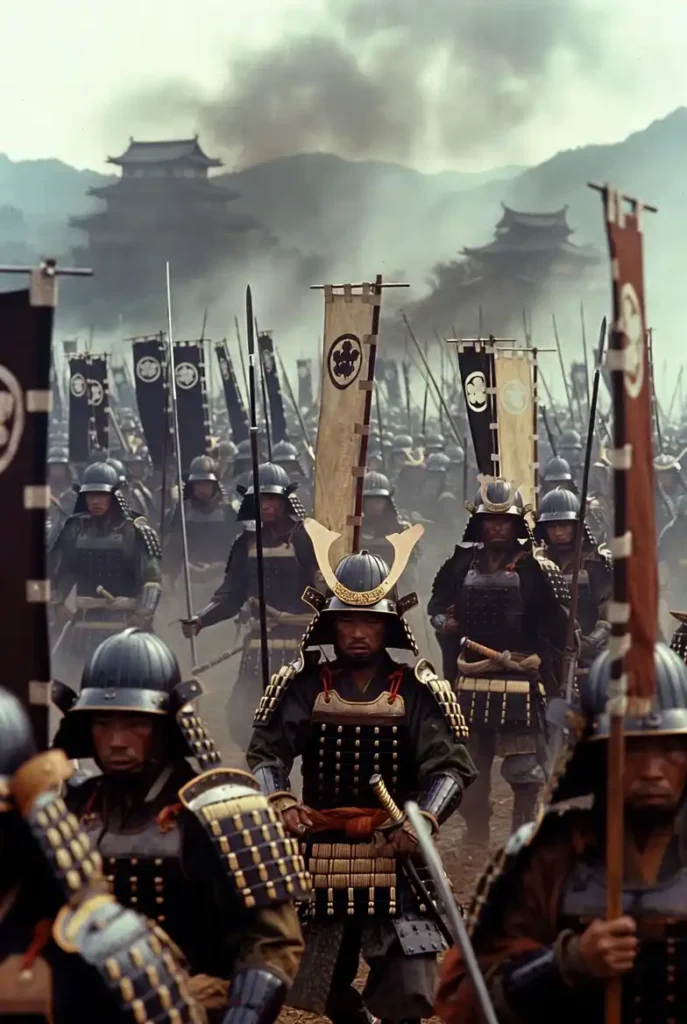
In short, Kagemusha is not a documentary but a poetic historical tragedy that feels more “real” than many strictly factual accounts. Its blend of painstaking accuracy and profound insight into the samurai soul—loyalty, illusion, and inevitable decline—makes it essential viewing for anyone interested in feudal Japan. If you love Ran or Seven Samurai, this is Kurosawa at his most mature and visually breathtaking. Highly recommended in the full 179-minute Japanese cut.
The Forges of the Modern Warrior: Master Artisans and Armorers
To walk the path of the bushi is to appreciate the profound weight of iron, leather, and silk. For those seeking to wrap themselves in the historical legacy of the samurai, several masterful workshops and digital armories not only craft these magnificent panoplies but deeply chronicle the evolution of the warrior class.
Iron Mountain Armory (samurai-armor.com / ironmountainarmory.com)
This armory is a revelation for both the martial artist and the historian. They masterfully detail the genealogy of yoroi (armor)—from the imposing, boxy silhouettes of the Heian mounted archers to the highly efficient, bullet-deflecting tōsei-gusoku (“modern equipment”) of the Warring States period. Beyond their rich historical guides, they handcraft fully functional, customizable armor sets, alongside authentic traditional garments like the hakama and the cross-over hakama-shita.
Marutake Armor Factory (marutake-yoroi.myshopify.com/en)
Located in Kagoshima Prefecture, Marutake is the undisputed titan of Japanese armor reproduction, commanding roughly ninety percent of the domestic market for replica armor used in cinema and historical festivals. Their online platform offers beautiful insights into the meticulous, traditional methods required to wear and maintain the armor, while selling breathtaking replicas of legendary warlords like Oda Nobunaga and Takeda Shingen.
Pacific Armory (pacificarmory.com)
For the uninitiated stepping into the world of Japanese metallurgy, Pacific Armory serves as a profound educational gateway. They beautifully demystify the complex terminology of the samurai panoply—breaking down the spiritual and practical purposes of the kabuto (helmet), the terrifying menpō (face mask), and the dō (cuirass). In tandem with this education, they supply handcrafted, authentic-style armor sets built for display, reenactment, and martial practice.
Sanctuaries of Antiquity: Museums and High-End Dealers
For the dedicated collector seeking to possess a genuine artifact forged centuries ago, these institutions bridge the gap between historical preservation and global commerce.
Samurai Museum Shop (samuraimuseum.jp/shop/)
Born from the Samurai Museum in Tokyo’s bustling Shinjuku district, this shop acts as an educational and cultural nexus. They publish detailed guides on how to legally acquire and care for authentic Japanese swords, while offering an astonishing inventory. Here, one can acquire museum-grade antique katanas, intricately carved tsuba (handguards), and magnificent Marutake replica armors.
Samurai Store (samuraistore.com)
This esteemed gallery operates with a deep reverence for the “ceremonial prestige aesthetic” of the Edo period. They offer a staggering array of 100% handcrafted replica armors, but their true allure lies in their curation of highly certified, antique yoroi and kabuto from the 16th to 19th centuries.
Giuseppe Piva Japanese Art (giuseppepiva.com)
Operating at the pinnacle of art dealing, this gallery offers deeply evocative, scholarly articles on the fundamental anatomy and construction of the samurai helmet. For the affluent collector, they offer extraordinarily rare, museum-quality antique armors and helmets, such as the exquisite Suji-bachi and Mōsunari kabuto.
The Path of the Martial Artist: Armaments and Traditional Garb
To understand the philosopher-poet heart of the samurai, one must look at the tools and garments that defined their daily, disciplined existence.
Tozando (tozandoshop.com / japanesesword.net)
Rooted in Kyoto, Tozando is an indispensable resource for the modern budō practitioner. Their blog is a treasure trove of historical research, exploring the daily routines, spiritual philosophies, and economic struggles of the Edo-period warrior. Alongside this profound storytelling, they sell an exhaustive array of martial arts equipment, newly forged katanas (shinsakuto), and traditional yoroi armor.
TrueKatana (truekatana.com)
This platform weaves evocative tales of historical samurai elegance, offering deep walkthroughs of the evolution of civil and martial clothing—from the restrictive kamishimo of the Edo courts to the breathable hitoe worn beneath armor. They cater to enthusiasts by selling a vast array of katanas, ninja swords, and complete Japanese samurai armor sets.
Katana Sword / Katana US (katana-sword.com / katana-us.com)
Delving into the invisible architecture of the warrior’s mind, their articles explore the intimate, spiritual relationship between the samurai, the sword as the “soul of the warrior,” and the overarching ethos of bushidō. Their storefront provides an extensive selection of custom blades, display swords, and samurai armor.
The Global Armories: Merchants of the Blade and Scale
The aesthetic of the samurai has transcended the borders of Japan, maintained by passionate global merchants who ensure the legacy of the bushi continues to echo around the world.
Kult of Athena (kultofathena.com)
As one of the largest global arms dealers, they chronicle the violent, beautiful evolution of the katana and the warriors who wielded it. Their vast inventory includes everything from raw blades to complete suits of samurai armor.
Suigenkyo Online Store (suigenkyo.store)
A beautiful digital space dedicated to preserving the history of Japanese craftsmanship. They offer deep cultural context and interviews with artisans, while serving as a primary vendor for the masterfully crafted Marutake samurai armor and exquisite civilian crafts.
Guardians Vault Australia (guardiansvaultaustralia.com)
This outfitter provides the physical foundation of the warrior’s attire. They offer traditional garments like the flowing hitatare kamishimo—the “upper and lower” clothing set—alongside samurai armor and weaponry.
Battle-Merchant (battlemerchant.com)
A sprawling European hub for historical reenactors. Their blog discusses the profound connection between Zen Buddhism, the bushidō code, and the art of swordsmanship. They supply a diverse range of armors, katanas, and maintenance kits.
Espadas y Más (espadasymas.com)
This Spanish marketplace explores the melancholic legacy of the rōnin (masterless samurai) and the profound bond of honor forged in steel. They cater to the European market with an array of anime-inspired weapons, historical Japanese helmets, and martial armor.
Wyrmwick (wyrmwick.com)
Though primarily focused on European and fantasy aesthetics, this UK-based armory provides high-quality polyurethane armor replicas for historical reenactment, film, and theater, offering an accessible entry point for those wishing to don the heavy mantle of the past.
- The primary weapon of the samuraiThere was no single primary weapon across their entire history; rather, their favored instrument of war evolved in harmony with the changing tides of battle and society. The wind howls across the plains of feudal Japan, carrying the scent of pine and impending conflict. When we picture the noble samurai standing amidst this tempest, our… Read more: The primary weapon of the samurai
- Kurosawa’s films influence modern stories like Star WarsWhen we gaze up at the starlit expanse of a cinematic galaxy far, far away, we are, in truth, looking down into the rain-soaked mud and mist of feudal Japan. Long before lightsabers hummed in the dark, the sharp ring of the samurai sword echoed through the visionary mind of Japanese auteur Akira Kurosawa. To understand the… Read more: Kurosawa’s films influence modern stories like Star Wars
- Mono no AwareIt fit not as a contradiction, but as the very heart of the samurai soul. Mono no aware — that exquisite, aching awareness of how beautiful things are precisely because they are fleeting — was never a soft indulgence for the bushi. It was the emotional and philosophical steel that made their hardness meaningful. The… Read more: Mono no Aware
- The Guardian of the Inner Sanctum: The Heavy Mantle of the Samurai Women (Oku-sama)Samurai women (Oku-sama) of the bushi (warrior class) were explicitly expected to defend their homes, estates, and castles as a fundamental duty rooted in loyalty to family, clan honor, and the samurai ethos. While men fought on distant battlefields, wives, mothers, and daughters served as the last line of protection for the household—especially during the… Read more: The Guardian of the Inner Sanctum: The Heavy Mantle of the Samurai Women (Oku-sama)
- The magnificent Owari Tokugawa helmet (kabuto) and menpō (face guard)To stand before the hereditary treasures of the Owari Tokugawa clan is to be confronted by the breathtaking weight of power, frozen in iron, lacquer, and silver. Housed within the hushed galleries of the Tokugawa Art Museum in Nagoya—a sanctuary preserving the unbroken lineage of the most senior branch of the Tokugawa shogunate—these artifacts tell… Read more: The magnificent Owari Tokugawa helmet (kabuto) and menpō (face guard)