The Seven Pillars of the Samurai Soul
To hold a blade capable of severing flesh and bone is a terrifying responsibility. In the quiet, mist-shrouded dawns of feudal Japan, the answer to this profound moral burden was not found in the sharpness of the steel, but in the invisible, philosophical architecture of the warrior’s soul.
For the samurai, the path of the sword was inextricably bound to the path of the pen and the spirit. This delicate balance was codified in an unwritten, evolving ethos known as bushidō—”The Way of the Warrior”. Drawing from the deep wells of Neo-Confucianism, Zen Buddhism, and Shinto, bushidō transformed provincial fighters into philosopher-poets and moral exemplars. While the exact interpretations of this code varied by clan and era, by the peaceful centuries of the Edo period, it coalesced into a profound ethical framework. This comprehensive philosophy for living a meaningful, disciplined life was governed by seven principal virtues.
The Whisper of the Katana: A Dawn Encounter with the Seven Virtues of Bushido
Picture this: mist clings to the ancient cedars of a mountain shrine at first light. A lone figure in faded hakama kneels before a simple altar, his katana resting across his knees like a trusted companion. The air smells of pine resin and distant rain. He does not pray for victory or glory. He whispers a single question that has echoed through centuries of Japanese soul: “How does a warrior live so that even death cannot diminish him?”
That question is Bushido—the Way of the Warrior. Not a rigid law carved in stone, but a living flame passed hand to hand from master to disciple, from battlefield to tea room, from feudal Japan to the quiet corners of our own restless hearts. And at its blazing center burn seven core virtues, the very heartbeat of the samurai spirit.
I have walked the old Tokaido road in my mind a thousand times, pored over crumbling scrolls and modern translations alike, and still these virtues move me like the first time I read them by lantern light. They are not dusty relics. They are a map for anyone who dares to live with honor in an age that often rewards the opposite.
The Seven Pillars:
Gi (義): Rectitude – The Unbending Spine of Justice
Gi is the virtue that turns steel into conscience. It is doing what is right even when no one is watching, even when every instinct screams to look the other way.
Imagine a young retainer whose lord has been murdered. The law of the land demands silence. Yet Gi rises like a drawn blade. The forty-seven ronin of Ako chose death over dishonor because Gi would not let them rest. Rectitude is not cold calculation; it is the quiet fire that says, “I would rather die upright than live bent.”
In our own lives, Gi asks the simplest and hardest question: Will you choose integrity when it costs you everything?
Yu (勇): Courage – The Calm Eye Within the Storm
Courage, Yu, is not the absence of fear. The samurai knew fear intimately—the dry mouth before the charge, the tremor in the wrist as arrows whistled past. Yu is the decision to act anyway, with perfect composure.
Miyamoto Musashi, that wandering sword-saint, wrote that true courage is “to do what is right at the moment of decision.” It is the mother who stands between her child and danger, the artist who bares his soul, the executive who refuses the shady deal. Yu turns the trembling hand steady and the racing heart into a drumbeat of purpose.
Jin (仁): Benevolence – The Gentle Rain on Parched Earth
Here is the surprise that still catches me off guard: the fiercest warriors cultivated Jin, compassion. A samurai’s sword could end a life in a heartbeat, yet his heart was commanded to protect the weak.
Toyotomi Hideyoshi, after conquering half of Japan, ordered the planting of cherry trees so that even the lowliest farmer could enjoy their beauty. Benevolence is strength tempered by mercy. It is the warlord sharing his rice with a starving enemy, the modern CEO who remembers the janitor’s name. Jin reminds us that true power flows not from domination, but from lifting others.
Rei (礼): Respect – The Silent Poetry of Conduct
Rei is far more than bowing correctly. It is the art of seeing the divine spark in every person and treating them accordingly. The samurai bowed to allies and enemies alike because respect was never about status—it was about recognizing shared humanity.
In the dojo, the lowest student was greeted with the same courtesy as the master. A teacup placed with care, a door slid shut without sound, a letter folded with precision—these were acts of Rei. In our frantic world of half-finished emails and ghosted conversations, Rei whispers: Slow down. See the other. Honor the moment.
Makoto (誠): Sincerity – The Mirror That Never Lies
Makoto means your word is your soul made audible. No hidden agendas, no polite deceptions, no social masks. When a samurai said “I will,” the universe itself could take that promise to the bank.
The great swordsman Yamaoka Tesshu once dueled a rival who had boasted he was unbeatable. Tesshu arrived, bowed, and simply said, “Let us begin.” His sincerity disarmed the man before steel ever crossed. Makoto is living so transparently that your actions and your heart are one unbroken reflection.
Meiyo (名誉): Honor – The Light That Outlives the Body
Meiyo is the reputation you carry beyond the grave. Samurai did not fear death; they feared a stained name. They trained, studied poetry, practiced calligraphy, and guarded their conduct because every choice either burnished or tarnished the light they would leave behind.
When the last of the forty-seven ronin placed his lord’s head upon the altar and then committed seppuku, he did so with a smile. His honor was complete. Meiyo asks us today: When your story is told, what will the listeners feel in their chests—pride or shame?
Chugi (忠義): Loyalty – The Unbreakable Thread
Chugi is the virtue that binds everything else together. Loyalty to lord, to family, to comrades, to one’s own highest self. It is the ronin who waits decades for the right moment to strike, the wife who tends her wounded husband without complaint, the friend who stands beside you when the world walks away.
Yet the deepest loyalty of all is to truth. The samurai understood that blind obedience was cowardice wearing a loyal mask. True Chugi demands discernment: serve what is worthy, and have the courage to question what is not.
The Flame We Still Carry
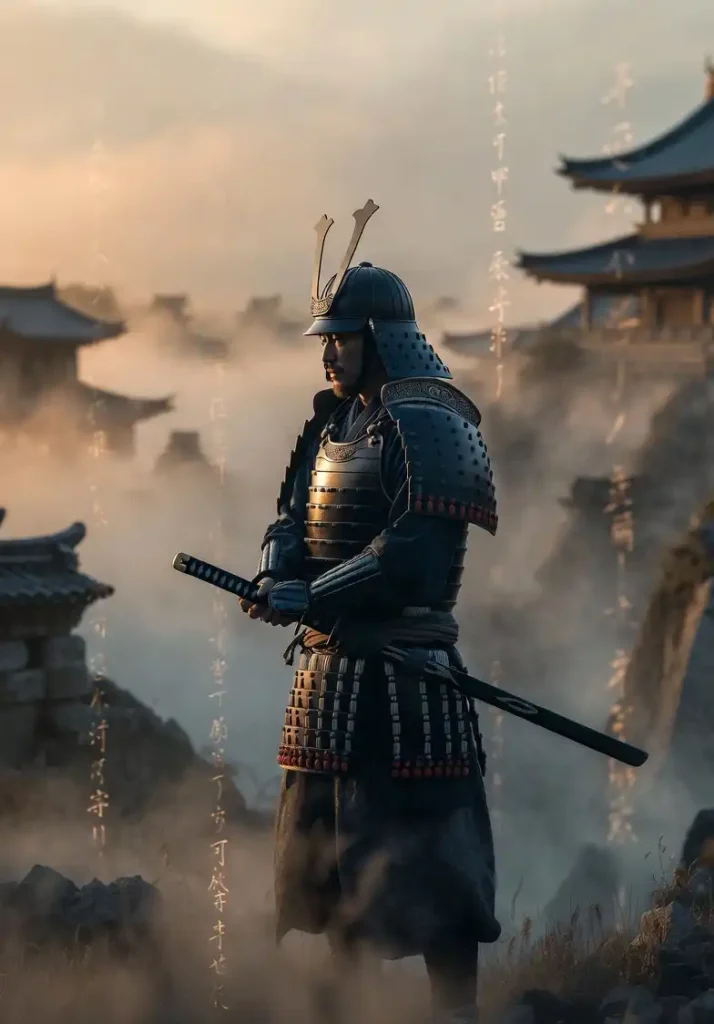
I close my eyes and see that solitary samurai rising from his dawn meditation. He sheathes his sword, straightens his shoulders, and steps into the world—not as a conqueror, but as a guardian of these seven living flames.
The beauty of Bushido is that its virtues were never meant for the battlefield alone. They were forged for life itself. In boardrooms and bedrooms, in quiet acts of courage and loud declarations of love, the seven virtues still whisper their ancient challenge:
Live so that your final breath can be taken without regret.
And so the journey continues—for you, for me, for every soul drawn to the way of the warrior-poet. The mist is lifting. The katana of the spirit is waiting.
Will you pick it up?
Your fellow traveler on The Way of The Samurai
The Forges of the Modern Warrior: Master Artisans and Armorers
To walk the path of the bushi is to appreciate the profound weight of iron, leather, and silk. For those seeking to wrap themselves in the historical legacy of the samurai, several masterful workshops and digital armories not only craft these magnificent panoplies but deeply chronicle the evolution of the warrior class.
Iron Mountain Armory (samurai-armor.com / ironmountainarmory.com)
This armory is a revelation for both the martial artist and the historian. They masterfully detail the genealogy of yoroi (armor)—from the imposing, boxy silhouettes of the Heian mounted archers to the highly efficient, bullet-deflecting tōsei-gusoku (“modern equipment”) of the Warring States period. Beyond their rich historical guides, they handcraft fully functional, customizable armor sets, alongside authentic traditional garments like the hakama and the cross-over hakama-shita.
Marutake Armor Factory (marutake-yoroi.myshopify.com/en)
Located in Kagoshima Prefecture, Marutake is the undisputed titan of Japanese armor reproduction, commanding roughly ninety percent of the domestic market for replica armor used in cinema and historical festivals. Their online platform offers beautiful insights into the meticulous, traditional methods required to wear and maintain the armor, while selling breathtaking replicas of legendary warlords like Oda Nobunaga and Takeda Shingen.
Pacific Armory (pacificarmory.com)
For the uninitiated stepping into the world of Japanese metallurgy, Pacific Armory serves as a profound educational gateway. They beautifully demystify the complex terminology of the samurai panoply—breaking down the spiritual and practical purposes of the kabuto (helmet), the terrifying menpō (face mask), and the dō (cuirass). In tandem with this education, they supply handcrafted, authentic-style armor sets built for display, reenactment, and martial practice.
Sanctuaries of Antiquity: Museums and High-End Dealers
For the dedicated collector seeking to possess a genuine artifact forged centuries ago, these institutions bridge the gap between historical preservation and global commerce.
Samurai Museum Shop (samuraimuseum.jp/shop/)
Born from the Samurai Museum in Tokyo’s bustling Shinjuku district, this shop acts as an educational and cultural nexus. They publish detailed guides on how to legally acquire and care for authentic Japanese swords, while offering an astonishing inventory. Here, one can acquire museum-grade antique katanas, intricately carved tsuba (handguards), and magnificent Marutake replica armors.
Samurai Store (samuraistore.com)
This esteemed gallery operates with a deep reverence for the “ceremonial prestige aesthetic” of the Edo period. They offer a staggering array of 100% handcrafted replica armors, but their true allure lies in their curation of highly certified, antique yoroi and kabuto from the 16th to 19th centuries.
Giuseppe Piva Japanese Art (giuseppepiva.com)
Operating at the pinnacle of art dealing, this gallery offers deeply evocative, scholarly articles on the fundamental anatomy and construction of the samurai helmet. For the affluent collector, they offer extraordinarily rare, museum-quality antique armors and helmets, such as the exquisite Suji-bachi and Mōsunari kabuto.
The Path of the Martial Artist: Armaments and Traditional Garb
To understand the philosopher-poet heart of the samurai, one must look at the tools and garments that defined their daily, disciplined existence.
Tozando (tozandoshop.com / japanesesword.net)
Rooted in Kyoto, Tozando is an indispensable resource for the modern budō practitioner. Their blog is a treasure trove of historical research, exploring the daily routines, spiritual philosophies, and economic struggles of the Edo-period warrior. Alongside this profound storytelling, they sell an exhaustive array of martial arts equipment, newly forged katanas (shinsakuto), and traditional yoroi armor.
TrueKatana (truekatana.com)
This platform weaves evocative tales of historical samurai elegance, offering deep walkthroughs of the evolution of civil and martial clothing—from the restrictive kamishimo of the Edo courts to the breathable hitoe worn beneath armor. They cater to enthusiasts by selling a vast array of katanas, ninja swords, and complete Japanese samurai armor sets.
Katana Sword / Katana US (katana-sword.com / katana-us.com)
Delving into the invisible architecture of the warrior’s mind, their articles explore the intimate, spiritual relationship between the samurai, the sword as the “soul of the warrior,” and the overarching ethos of bushidō. Their storefront provides an extensive selection of custom blades, display swords, and samurai armor.
The Global Armories: Merchants of the Blade and Scale
The aesthetic of the samurai has transcended the borders of Japan, maintained by passionate global merchants who ensure the legacy of the bushi continues to echo around the world.
Kult of Athena (kultofathena.com)
As one of the largest global arms dealers, they chronicle the violent, beautiful evolution of the katana and the warriors who wielded it. Their vast inventory includes everything from raw blades to complete suits of samurai armor.
Suigenkyo Online Store (suigenkyo.store)
A beautiful digital space dedicated to preserving the history of Japanese craftsmanship. They offer deep cultural context and interviews with artisans, while serving as a primary vendor for the masterfully crafted Marutake samurai armor and exquisite civilian crafts.
Guardians Vault Australia (guardiansvaultaustralia.com)
This outfitter provides the physical foundation of the warrior’s attire. They offer traditional garments like the flowing hitatare kamishimo—the “upper and lower” clothing set—alongside samurai armor and weaponry.
Battle-Merchant (battlemerchant.com)
A sprawling European hub for historical reenactors. Their blog discusses the profound connection between Zen Buddhism, the bushidō code, and the art of swordsmanship. They supply a diverse range of armors, katanas, and maintenance kits.
Espadas y Más (espadasymas.com)
This Spanish marketplace explores the melancholic legacy of the rōnin (masterless samurai) and the profound bond of honor forged in steel. They cater to the European market with an array of anime-inspired weapons, historical Japanese helmets, and martial armor.
Wyrmwick (wyrmwick.com)
Though primarily focused on European and fantasy aesthetics, this UK-based armory provides high-quality polyurethane armor replicas for historical reenactment, film, and theater, offering an accessible entry point for those wishing to don the heavy mantle of the past.
- The primary weapon of the samuraiThere was no single primary weapon across their entire history; rather, their favored instrument of war evolved in harmony with the changing tides of battle and society. The wind howls across the plains of feudal Japan, carrying the scent of pine and impending conflict. When we picture the noble samurai standing amidst this tempest, our… Read more: The primary weapon of the samurai
- Kurosawa’s films influence modern stories like Star WarsWhen we gaze up at the starlit expanse of a cinematic galaxy far, far away, we are, in truth, looking down into the rain-soaked mud and mist of feudal Japan. Long before lightsabers hummed in the dark, the sharp ring of the samurai sword echoed through the visionary mind of Japanese auteur Akira Kurosawa. To understand the… Read more: Kurosawa’s films influence modern stories like Star Wars
- Mono no AwareIt fit not as a contradiction, but as the very heart of the samurai soul. Mono no aware — that exquisite, aching awareness of how beautiful things are precisely because they are fleeting — was never a soft indulgence for the bushi. It was the emotional and philosophical steel that made their hardness meaningful. The… Read more: Mono no Aware
- The Guardian of the Inner Sanctum: The Heavy Mantle of the Samurai Women (Oku-sama)Samurai women (Oku-sama) of the bushi (warrior class) were explicitly expected to defend their homes, estates, and castles as a fundamental duty rooted in loyalty to family, clan honor, and the samurai ethos. While men fought on distant battlefields, wives, mothers, and daughters served as the last line of protection for the household—especially during the… Read more: The Guardian of the Inner Sanctum: The Heavy Mantle of the Samurai Women (Oku-sama)
- The magnificent Owari Tokugawa helmet (kabuto) and menpō (face guard)To stand before the hereditary treasures of the Owari Tokugawa clan is to be confronted by the breathtaking weight of power, frozen in iron, lacquer, and silver. Housed within the hushed galleries of the Tokugawa Art Museum in Nagoya—a sanctuary preserving the unbroken lineage of the most senior branch of the Tokugawa shogunate—these artifacts tell… Read more: The magnificent Owari Tokugawa helmet (kabuto) and menpō (face guard)