To stand before the hereditary treasures of the Owari Tokugawa clan is to be confronted by the breathtaking weight of power, frozen in iron, lacquer, and silver. Housed within the hushed galleries of the Tokugawa Art Museum in Nagoya—a sanctuary preserving the unbroken lineage of the most senior branch of the Tokugawa shogunate—these artifacts tell the story of a warrior elite transitioning from the chaos of the battlefield into an era of profound, aristocratic peace.
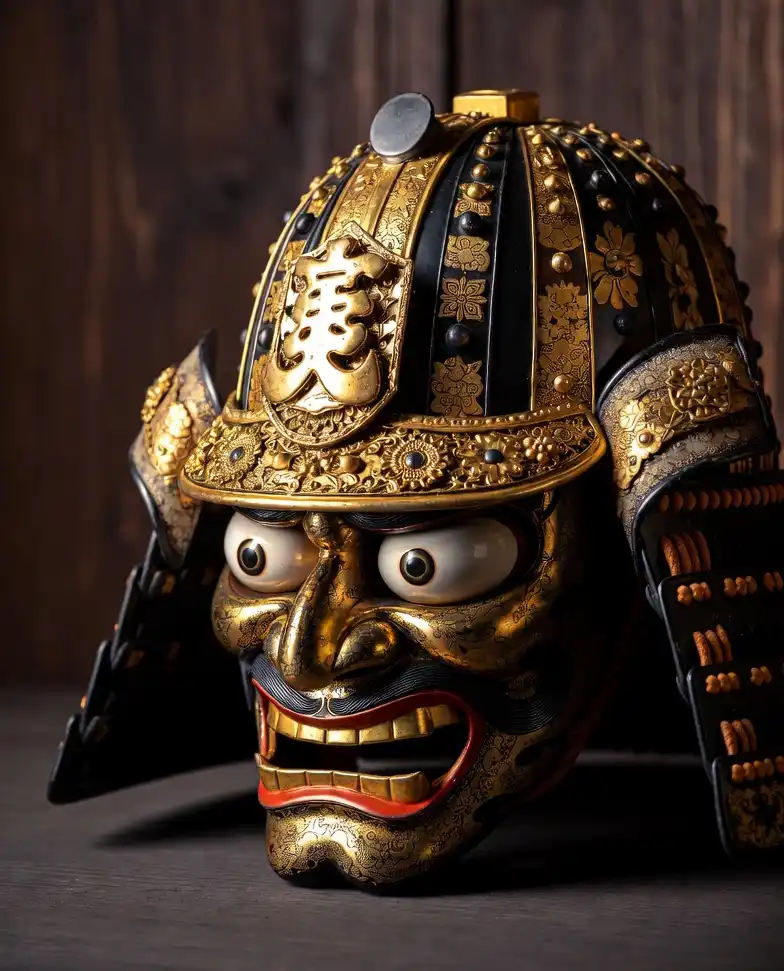
While the historical archives we currently consult do not isolate the meticulous, rivet-by-rivet details of one singular Owari Tokugawa helmet and mask, they do illuminate the breathtaking “silver-foil armor of the Owari lords” and the magnificent daimyo-class headgear that defined the Tokugawa legacy. Through these surviving masterpieces, we can weave a vivid tapestry of the kabuto (helmet) and menpō (facial armor) that crowned the rulers of early modern Japan.
The Crown of the Daimyo: The Architecture of the Kabuto
For the samurai, the kabuto was far more than protective headgear; it was the spiritual and physical apex of the warrior’s identity. By the Edo period (1603–1868), when the Tokugawa family had pacified the nation, the creation of armor was elevated from a mere military craft to a profound art form. The master armorers of the era, such as those from the legendary Myōchin school—who enjoyed the direct patronage of the shogun and wealthy lords—were revered as artists.
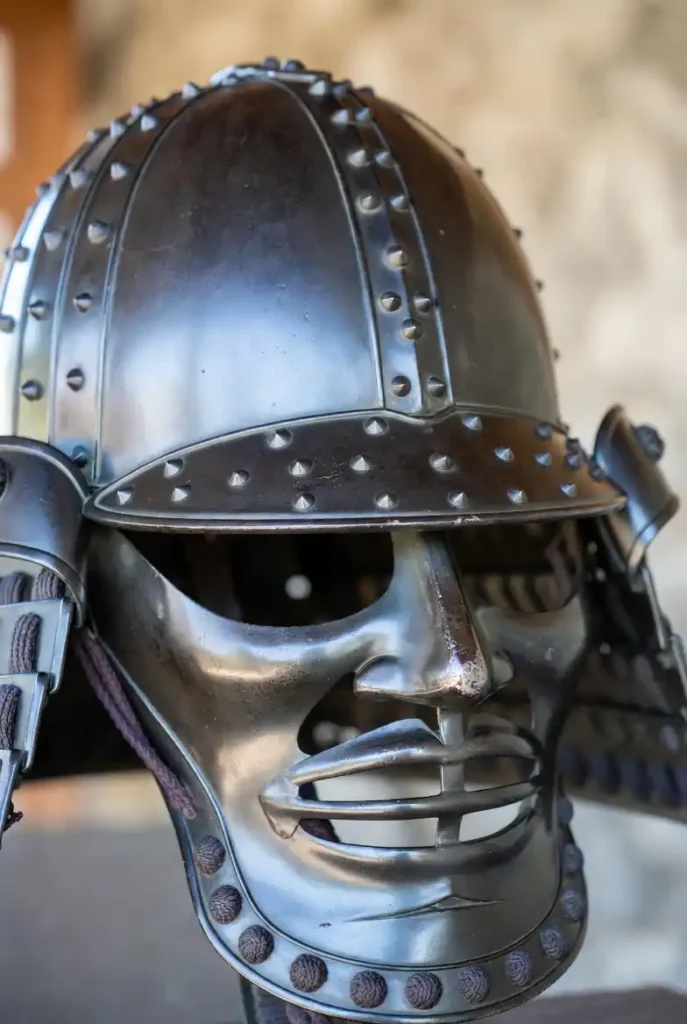
The foundation of the helmet, known as the hachi (bowl), was meticulously constructed from interlocking iron plates. In the most magnificent Tokugawa examples, these bowls were often ridged (a style known as sujibachi), featuring dozens of interlocking plates that provided immense structural strength and breathtaking visual symmetry. Suspended from the base of the hachi was the shikoro (neck guard), a cascading curtain of iron or leather lamellae laced together with vibrant silk cords, designed to protect the vulnerable neck while allowing the warrior to turn his head with fluid grace.
To signify their unquestionable authority, the armor of the Tokugawa daimyo was heavily adorned with the family’s iconic kamon (crest). The triple hollyhock leaf crest would be proudly displayed across the armor’s components, asserting the divine right of the wearer. The front of the kabuto was crowned by the maedate (frontal crest). In high-ranking armor, these crests were masterpieces of gilded bronze or lacquered wood, often taking the shape of stylized horns, fearsome mythical lions (shishi), or the flaming jewel of Buddhism. Some helmets even bore the likeness of Fudō Myōō, the Buddhist deity of wisdom and patron of swordsmen, standing amidst a wall of carved flames.
The Face of Wrath: The Artistry of the Menpō
Beneath the soaring crest of the helmet sat the menpō (also known as mengu), the armored face mask. Attached securely to the heavy kabuto by intricate cords, the menpō served a vital dual purpose: it anchored the weight of the helmet to the head, and it projected an aura of supernatural terror.
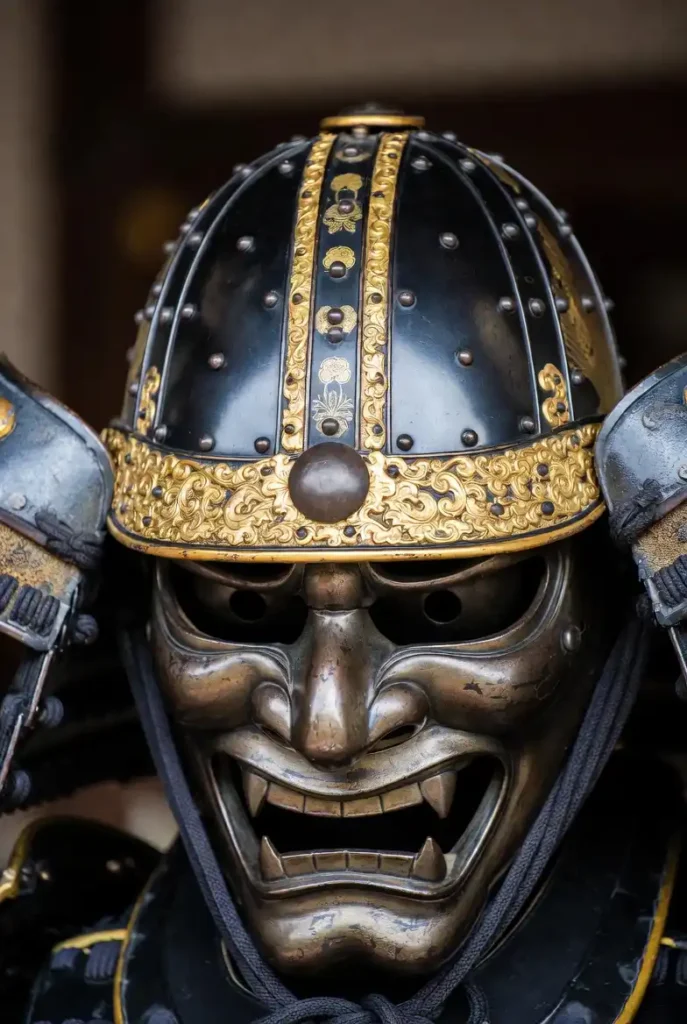
The craftsmen who forged these masks did not merely shape iron; they sculpted emotion. A magnificent menpō was often crafted into the snarling visage of an oni (demon) or an angry deity, featuring bristling mustaches made of animal hair, flared nostrils, and fierce teeth lacquered in gold or silver. Some daimyo commissioned the sōmen, a full-face mask that covered the warrior entirely, sometimes modeled after the monumental, roaring statues of the Agyō guardian deities that stand watch at the gates of Buddhist temples. By obscuring their human features behind these terrifying, immutable expressions, the Tokugawa lords ceased to be mere men and became the avatars of war and judgment.
Silver Foil and the Aesthetics of Peace
The Owari Tokugawa clan, as the most senior of the three sub-branches of the ruling family, possessed wealth and status that was almost unrivaled. Their armor, including the terrifyingly beautiful silver-foil suits showcased in exhibitions like “Brothers in Arms,” reflects a fascinating paradox of the bushi class.
Because the Edo period was an era of prolonged peace, the kabuto and menpō were no longer destined to be battered by enemy swords or pierced by matchlock fire. Instead, they became symbols of “ceremonial prestige aesthetic,” worn during the grand, compulsory processions to the capital of Edo. The silver foil, the gilded horns, and the snarling iron faces were designed to be seen, to overawe political rivals, and to remind the populace that beneath the refined poetry and tea ceremonies of the daimyo, the lethal spirit of the samurai remained sharp, waiting in the shadows.
Based on the archives from the Tokugawa Art Museum, the armor and helmets of the Owari Tokugawa clan—the most senior branch of the Tokugawa Shogunate—represent the pinnacle of Edo-period craftsmanship, where functional protection evolved into high-status “ceremonial iconography.”
The Owari Tokugawa Kabuto (Helmet)
The helmets of the Owari lords are characterized by their “terrifying beauty” and the use of precious materials that signaled absolute authority. A defining feature of this lineage’s collection is the Silver-Foil Armor, specifically known for its striking silver coat and white lacing.
- Materials and Finish: These helmets often utilized iron bowls (hachi) finished with layers of silver foil. During the peaceful Edo period, the focus shifted from battlefield utility to “pomp,” designed to glorify the owner’s immense wealth and power.
- The Myōchin School: Many of these elite pieces are attributed to the Myōchin School, a prestigious lineage of armorers particularly renowned during the Edo era for their meticulous metalwork.
- Aesthetic Excess: The helmets frequently featured large tufts of horsehair and elaborate crests (maedate). Unlike the functional helmets of the earlier Sengoku (Warring States) period, the Owari Tokugawa pieces emphasized visual grandeur and the refined presence of the daimyō.
The Menpō (Face Mask)
The menpō (iron face mask) served a dual purpose: providing physical protection for the face while projecting a psychological image of an unwavering, fierce warrior.
- Design and Expression: The Owari Tokugawa masks are often described as “terrifyingly beautiful” or “grimacing.” They were hand-forged from patinated steel to resemble ancestral spirits, demons, or formidable older warriors.
- The “Sōmen” Variant: Some high-ranking pieces in the collection include the sōmen, a full-face mask. These were often designed so the upper part could be unhinged, allowing it to be used as a half-mask (menpō) depending on the ceremony or need.
- Family Heraldry: Many masks and helmets in this collection are explicitly marked with the Wakizaka or Owari Tokugawa family coat of arms (kamon), ensuring the wearer’s lineage was identifiable even in full regalia.
Cultural Significance
These artifacts were more than just equipment; they were central to the “dual path” of the brush and the sword. The Tokugawa Art Museum showcases these items alongside tea ceremony utensils and Nō theater artifacts to illustrate that for an Owari lord, martial readiness and cultural refinement were inseparable.
The upcoming 2026 exhibition “Brothers in Arms” will highlight these specific items—particularly the silver-foil suits—to explore the psychological weight of power held by the men who unified Japan.
The Forges of the Modern Warrior: Master Artisans and Armorers
To walk the path of the bushi is to appreciate the profound weight of iron, leather, and silk. For those seeking to wrap themselves in the historical legacy of the samurai, several masterful workshops and digital armories not only craft these magnificent panoplies but deeply chronicle the evolution of the warrior class.
Iron Mountain Armory (samurai-armor.com / ironmountainarmory.com)
This armory is a revelation for both the martial artist and the historian. They masterfully detail the genealogy of yoroi (armor)—from the imposing, boxy silhouettes of the Heian mounted archers to the highly efficient, bullet-deflecting tōsei-gusoku (“modern equipment”) of the Warring States period. Beyond their rich historical guides, they handcraft fully functional, customizable armor sets, alongside authentic traditional garments like the hakama and the cross-over hakama-shita.
Marutake Armor Factory (marutake-yoroi.myshopify.com/en)
Located in Kagoshima Prefecture, Marutake is the undisputed titan of Japanese armor reproduction, commanding roughly ninety percent of the domestic market for replica armor used in cinema and historical festivals. Their online platform offers beautiful insights into the meticulous, traditional methods required to wear and maintain the armor, while selling breathtaking replicas of legendary warlords like Oda Nobunaga and Takeda Shingen.
Pacific Armory (pacificarmory.com)
For the uninitiated stepping into the world of Japanese metallurgy, Pacific Armory serves as a profound educational gateway. They beautifully demystify the complex terminology of the samurai panoply—breaking down the spiritual and practical purposes of the kabuto (helmet), the terrifying menpō (face mask), and the dō (cuirass). In tandem with this education, they supply handcrafted, authentic-style armor sets built for display, reenactment, and martial practice.
Sanctuaries of Antiquity: Museums and High-End Dealers
For the dedicated collector seeking to possess a genuine artifact forged centuries ago, these institutions bridge the gap between historical preservation and global commerce.
Samurai Museum Shop (samuraimuseum.jp/shop/)
Born from the Samurai Museum in Tokyo’s bustling Shinjuku district, this shop acts as an educational and cultural nexus. They publish detailed guides on how to legally acquire and care for authentic Japanese swords, while offering an astonishing inventory. Here, one can acquire museum-grade antique katanas, intricately carved tsuba (handguards), and magnificent Marutake replica armors.
Samurai Store (samuraistore.com)
This esteemed gallery operates with a deep reverence for the “ceremonial prestige aesthetic” of the Edo period. They offer a staggering array of 100% handcrafted replica armors, but their true allure lies in their curation of highly certified, antique yoroi and kabuto from the 16th to 19th centuries.
Giuseppe Piva Japanese Art (giuseppepiva.com)
Operating at the pinnacle of art dealing, this gallery offers deeply evocative, scholarly articles on the fundamental anatomy and construction of the samurai helmet. For the affluent collector, they offer extraordinarily rare, museum-quality antique armors and helmets, such as the exquisite Suji-bachi and Mōsunari kabuto.
The Path of the Martial Artist: Armaments and Traditional Garb
To understand the philosopher-poet heart of the samurai, one must look at the tools and garments that defined their daily, disciplined existence.
Tozando (tozandoshop.com / japanesesword.net)
Rooted in Kyoto, Tozando is an indispensable resource for the modern budō practitioner. Their blog is a treasure trove of historical research, exploring the daily routines, spiritual philosophies, and economic struggles of the Edo-period warrior. Alongside this profound storytelling, they sell an exhaustive array of martial arts equipment, newly forged katanas (shinsakuto), and traditional yoroi armor.
TrueKatana (truekatana.com)
This platform weaves evocative tales of historical samurai elegance, offering deep walkthroughs of the evolution of civil and martial clothing—from the restrictive kamishimo of the Edo courts to the breathable hitoe worn beneath armor. They cater to enthusiasts by selling a vast array of katanas, ninja swords, and complete Japanese samurai armor sets.
Katana Sword / Katana US (katana-sword.com / katana-us.com)
Delving into the invisible architecture of the warrior’s mind, their articles explore the intimate, spiritual relationship between the samurai, the sword as the “soul of the warrior,” and the overarching ethos of bushidō. Their storefront provides an extensive selection of custom blades, display swords, and samurai armor.
The Global Armories: Merchants of the Blade and Scale
The aesthetic of the samurai has transcended the borders of Japan, maintained by passionate global merchants who ensure the legacy of the bushi continues to echo around the world.
Kult of Athena (kultofathena.com)
As one of the largest global arms dealers, they chronicle the violent, beautiful evolution of the katana and the warriors who wielded it. Their vast inventory includes everything from raw blades to complete suits of samurai armor.
Suigenkyo Online Store (suigenkyo.store)
A beautiful digital space dedicated to preserving the history of Japanese craftsmanship. They offer deep cultural context and interviews with artisans, while serving as a primary vendor for the masterfully crafted Marutake samurai armor and exquisite civilian crafts.
Guardians Vault Australia (guardiansvaultaustralia.com)
This outfitter provides the physical foundation of the warrior’s attire. They offer traditional garments like the flowing hitatare kamishimo—the “upper and lower” clothing set—alongside samurai armor and weaponry.
Battle-Merchant (battlemerchant.com)
A sprawling European hub for historical reenactors. Their blog discusses the profound connection between Zen Buddhism, the bushidō code, and the art of swordsmanship. They supply a diverse range of armors, katanas, and maintenance kits.
Espadas y Más (espadasymas.com)
This Spanish marketplace explores the melancholic legacy of the rōnin (masterless samurai) and the profound bond of honor forged in steel. They cater to the European market with an array of anime-inspired weapons, historical Japanese helmets, and martial armor.
Wyrmwick (wyrmwick.com)
Though primarily focused on European and fantasy aesthetics, this UK-based armory provides high-quality polyurethane armor replicas for historical reenactment, film, and theater, offering an accessible entry point for those wishing to don the heavy mantle of the past.
- The primary weapon of the samuraiThere was no single primary weapon across their entire history; rather, their favored instrument of war evolved in harmony with the changing tides of battle and society. The wind howls across the plains of feudal Japan, carrying the scent of pine and impending conflict. When we picture the noble samurai standing amidst this tempest, our… Read more: The primary weapon of the samurai
- Kurosawa’s films influence modern stories like Star WarsWhen we gaze up at the starlit expanse of a cinematic galaxy far, far away, we are, in truth, looking down into the rain-soaked mud and mist of feudal Japan. Long before lightsabers hummed in the dark, the sharp ring of the samurai sword echoed through the visionary mind of Japanese auteur Akira Kurosawa. To understand the… Read more: Kurosawa’s films influence modern stories like Star Wars
- Mono no AwareIt fit not as a contradiction, but as the very heart of the samurai soul. Mono no aware — that exquisite, aching awareness of how beautiful things are precisely because they are fleeting — was never a soft indulgence for the bushi. It was the emotional and philosophical steel that made their hardness meaningful. The… Read more: Mono no Aware
- The Guardian of the Inner Sanctum: The Heavy Mantle of the Samurai Women (Oku-sama)Samurai women (Oku-sama) of the bushi (warrior class) were explicitly expected to defend their homes, estates, and castles as a fundamental duty rooted in loyalty to family, clan honor, and the samurai ethos. While men fought on distant battlefields, wives, mothers, and daughters served as the last line of protection for the household—especially during the… Read more: The Guardian of the Inner Sanctum: The Heavy Mantle of the Samurai Women (Oku-sama)
- The magnificent Owari Tokugawa helmet (kabuto) and menpō (face guard)To stand before the hereditary treasures of the Owari Tokugawa clan is to be confronted by the breathtaking weight of power, frozen in iron, lacquer, and silver. Housed within the hushed galleries of the Tokugawa Art Museum in Nagoya—a sanctuary preserving the unbroken lineage of the most senior branch of the Tokugawa shogunate—these artifacts tell… Read more: The magnificent Owari Tokugawa helmet (kabuto) and menpō (face guard)