When the golden age of the American cowboy picture began to wane in the mid-twentieth century, Hollywood filmmakers found themselves staring into a creative abyss. They needed a new mythology, a deeper well of moral ambiguity and kinetic violence. They found their salvation across the Pacific, within the misty, blood-soaked tapestries of the jidaigeki (period dramas) crafted by the masterful Japanese auteur Akira Kurosawa.
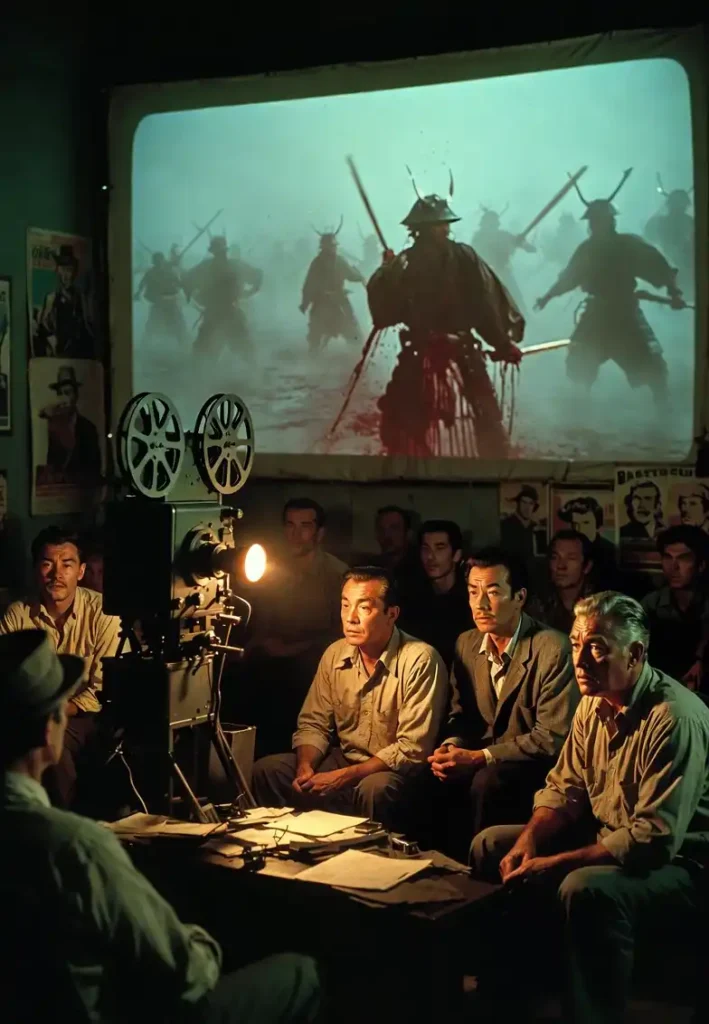
The cultural exchange between the desolate American frontier and the rigid, crumbling society of feudal Japan was profound. Kurosawa, who himself idolized the sweeping Westerns of American director John Ford, had taken the DNA of the Western and forged it into the chanbara (sword-fighting) genre. In return, Western filmmakers eagerly adopted Kurosawa’s flawed, stoic warriors, translating the ronin (masterless samurai) into the lone gunslinger.
Here is how the legacy of the blade was recast in the iron of the six-shooter.
The Dust of the Frontier: The Magnificent Seven and the Spirit of Seven Samurai
To understand the architecture of the modern ensemble action film, we must look to Kurosawa’s 1954 masterpiece, Seven Samurai. The film told the grueling, majestic story of desperate farmers hiring a motley crew of impoverished samurai to defend their harvest from marauding bandits. It was a profound meditation on class, sacrifice, and the fading relevance of the warrior caste.
Just six years later, director John Sturges transplanted this exact narrative skeleton into the sun-scorched earth of the American Wild West with The Magnificent Seven (1960). The beleaguered Japanese peasants became Mexican villagers, and the noble swordsmen were reborn as hired gunslingers, played by Hollywood titans like Steve McQueen, Yul Brynner, and Charles Bronson. While Sturges’s adaptation lacked the overwhelming, rain-lashed despair of Kurosawa’s three-hour epic, it successfully codified the “assembling the team” trope that remains a pillar of Western cinema today.
A Fistful of Yen: Yojimbo and the Birth of the Spaghetti Western
Perhaps no cinematic translation is more famous—or more legally fraught—than Sergio Leone’s unauthorized 1964 adaptation of Kurosawa’s Yojimbo (1961). Kurosawa’s original film starred the legendary Toshiro Mifune as Sanjuro, a cynical, scratching, world-weary ronin who wanders into a town torn apart by two corrupt merchant factions and decides to play them against one another for his own amusement and a hidden sense of justice.
Leone recognized that this morally grey anti-hero was the perfect antidote to the clean-cut, righteous cowboys of 1950s America. He transposed Yojimbo into the gritty, sweat-stained landscape of A Fistful of Dollars (1964), effectively giving birth to the Spaghetti Western genre. Toshiro Mifune’s nameless, manipulating swordsman became Clint Eastwood’s iconic “Man with No Name”. Leone lifted Kurosawa’s plot and characters so directly that Toho Studios sued on Kurosawa’s behalf; the lawsuit was successful, and Kurosawa famously earned more money from the Italian remake than he did from his own original film.
The savage intensity of Yojimbo rippled further into European cinema, deeply influencing Sergio Corbucci’s ultra-violent 1966 Spaghetti Western Django. Starring Franco Nero, Django similarly features a mysterious, charismatic gunslinger who arrives in a miserable, mud-soaked town divided by two feuding gangs, sparking a violent confrontation that mirrors the devastation wrought by Mifune’s blade.
The Fractured Truth of Rashomon in the Wild West
While Kurosawa is most celebrated for his kinetic action, his profound philosophical inquiries also found their way into the American West. His 1950 triumph, Rashomon, revolutionized cinema by utilizing the concept of the unreliable narrator—presenting four conflicting, self-serving accounts of a samurai’s murder and the rape of his wife.
In 1964, director Martin Ritt adapted this haunting exploration of subjective truth into the Western film The Outrage. Ritt replaced Kurosawa’s bandit, samurai, and woodcutter with archetypes fitting the frontier: a Mexican bandit (played by Paul Newman), a Southern gentleman, a prospector, and a preacher. Though The Outrage did not achieve the legendary status of its Japanese predecessor, it remains a fascinating testament to how the moral ambiguity of Kurosawa’s feudal Japan perfectly suited the lawless expanse of the Wild West.
Roaring Twenties and the Space Age: The Evolving Frontier
The aesthetic and narrative influence of Kurosawa’s samurai epics refused to remain confined to horseback and dusty trails. Walter Hill’s 1996 film Last Man Standing took the exact plot of Yojimbo and shifted the setting to a desolate, Prohibition-era Texas town, swapping the katana for twin M1911 pistols wielded by Bruce Willis.
Even beyond the terrestrial frontier, Kurosawa’s bushi (warrior) ethos provided the architectural blueprint for the greatest space Western of our time: Star Wars. George Lucas leaned heavily on Kurosawa’s 1958 adventure The Hidden Fortress to construct A New Hope (1977), borrowing the film’s technique of telling a grand, sweeping epic from the perspective of two bumbling, lowly peasants—the direct ancestors of R2-D2 and C-3PO.
Decades later, the Star Wars universe returned to its jidaigeki roots with the live-action series The Mandalorian. This modern space Western operates as a beautiful homage to the solitary warrior wandering the wasteland, with entire episodes lifting the narrative structure of Yojimbo—such as the protagonist defending a helpless village from raiders—proving that the spirit of the samurai continues to cast a long, beautiful shadow over the cinematic frontier.
The Forges of the Modern Warrior: Master Artisans and Armorers
To walk the path of the bushi is to appreciate the profound weight of iron, leather, and silk. For those seeking to wrap themselves in the historical legacy of the samurai, several masterful workshops and digital armories not only craft these magnificent panoplies but deeply chronicle the evolution of the warrior class.
Iron Mountain Armory (samurai-armor.com / ironmountainarmory.com)
This armory is a revelation for both the martial artist and the historian. They masterfully detail the genealogy of yoroi (armor)—from the imposing, boxy silhouettes of the Heian mounted archers to the highly efficient, bullet-deflecting tōsei-gusoku (“modern equipment”) of the Warring States period. Beyond their rich historical guides, they handcraft fully functional, customizable armor sets, alongside authentic traditional garments like the hakama and the cross-over hakama-shita.
Marutake Armor Factory (marutake-yoroi.myshopify.com/en)
Located in Kagoshima Prefecture, Marutake is the undisputed titan of Japanese armor reproduction, commanding roughly ninety percent of the domestic market for replica armor used in cinema and historical festivals. Their online platform offers beautiful insights into the meticulous, traditional methods required to wear and maintain the armor, while selling breathtaking replicas of legendary warlords like Oda Nobunaga and Takeda Shingen.
Pacific Armory (pacificarmory.com)
For the uninitiated stepping into the world of Japanese metallurgy, Pacific Armory serves as a profound educational gateway. They beautifully demystify the complex terminology of the samurai panoply—breaking down the spiritual and practical purposes of the kabuto (helmet), the terrifying menpō (face mask), and the dō (cuirass). In tandem with this education, they supply handcrafted, authentic-style armor sets built for display, reenactment, and martial practice.
Sanctuaries of Antiquity: Museums and High-End Dealers
For the dedicated collector seeking to possess a genuine artifact forged centuries ago, these institutions bridge the gap between historical preservation and global commerce.
Samurai Museum Shop (samuraimuseum.jp/shop/)
Born from the Samurai Museum in Tokyo’s bustling Shinjuku district, this shop acts as an educational and cultural nexus. They publish detailed guides on how to legally acquire and care for authentic Japanese swords, while offering an astonishing inventory. Here, one can acquire museum-grade antique katanas, intricately carved tsuba (handguards), and magnificent Marutake replica armors.
Samurai Store (samuraistore.com)
This esteemed gallery operates with a deep reverence for the “ceremonial prestige aesthetic” of the Edo period. They offer a staggering array of 100% handcrafted replica armors, but their true allure lies in their curation of highly certified, antique yoroi and kabuto from the 16th to 19th centuries.
Giuseppe Piva Japanese Art (giuseppepiva.com)
Operating at the pinnacle of art dealing, this gallery offers deeply evocative, scholarly articles on the fundamental anatomy and construction of the samurai helmet. For the affluent collector, they offer extraordinarily rare, museum-quality antique armors and helmets, such as the exquisite Suji-bachi and Mōsunari kabuto.
The Path of the Martial Artist: Armaments and Traditional Garb
To understand the philosopher-poet heart of the samurai, one must look at the tools and garments that defined their daily, disciplined existence.
Tozando (tozandoshop.com / japanesesword.net)
Rooted in Kyoto, Tozando is an indispensable resource for the modern budō practitioner. Their blog is a treasure trove of historical research, exploring the daily routines, spiritual philosophies, and economic struggles of the Edo-period warrior. Alongside this profound storytelling, they sell an exhaustive array of martial arts equipment, newly forged katanas (shinsakuto), and traditional yoroi armor.
TrueKatana (truekatana.com)
This platform weaves evocative tales of historical samurai elegance, offering deep walkthroughs of the evolution of civil and martial clothing—from the restrictive kamishimo of the Edo courts to the breathable hitoe worn beneath armor. They cater to enthusiasts by selling a vast array of katanas, ninja swords, and complete Japanese samurai armor sets.
Katana Sword / Katana US (katana-sword.com / katana-us.com)
Delving into the invisible architecture of the warrior’s mind, their articles explore the intimate, spiritual relationship between the samurai, the sword as the “soul of the warrior,” and the overarching ethos of bushidō. Their storefront provides an extensive selection of custom blades, display swords, and samurai armor.
The Global Armories: Merchants of the Blade and Scale
The aesthetic of the samurai has transcended the borders of Japan, maintained by passionate global merchants who ensure the legacy of the bushi continues to echo around the world.
Kult of Athena (kultofathena.com)
As one of the largest global arms dealers, they chronicle the violent, beautiful evolution of the katana and the warriors who wielded it. Their vast inventory includes everything from raw blades to complete suits of samurai armor.
Suigenkyo Online Store (suigenkyo.store)
A beautiful digital space dedicated to preserving the history of Japanese craftsmanship. They offer deep cultural context and interviews with artisans, while serving as a primary vendor for the masterfully crafted Marutake samurai armor and exquisite civilian crafts.
Guardians Vault Australia (guardiansvaultaustralia.com)
This outfitter provides the physical foundation of the warrior’s attire. They offer traditional garments like the flowing hitatare kamishimo—the “upper and lower” clothing set—alongside samurai armor and weaponry.
Battle-Merchant (battlemerchant.com)
A sprawling European hub for historical reenactors. Their blog discusses the profound connection between Zen Buddhism, the bushidō code, and the art of swordsmanship. They supply a diverse range of armors, katanas, and maintenance kits.
Espadas y Más (espadasymas.com)
This Spanish marketplace explores the melancholic legacy of the rōnin (masterless samurai) and the profound bond of honor forged in steel. They cater to the European market with an array of anime-inspired weapons, historical Japanese helmets, and martial armor.
Wyrmwick (wyrmwick.com)
Though primarily focused on European and fantasy aesthetics, this UK-based armory provides high-quality polyurethane armor replicas for historical reenactment, film, and theater, offering an accessible entry point for those wishing to don the heavy mantle of the past.
- The primary weapon of the samuraiThere was no single primary weapon across their entire history; rather, their favored instrument of war evolved in harmony with the changing tides of battle and society. The wind howls across the plains of feudal Japan, carrying the scent of pine and impending conflict. When we picture the noble samurai standing amidst this tempest, our… Read more: The primary weapon of the samurai
- Kurosawa’s films influence modern stories like Star WarsWhen we gaze up at the starlit expanse of a cinematic galaxy far, far away, we are, in truth, looking down into the rain-soaked mud and mist of feudal Japan. Long before lightsabers hummed in the dark, the sharp ring of the samurai sword echoed through the visionary mind of Japanese auteur Akira Kurosawa. To understand the… Read more: Kurosawa’s films influence modern stories like Star Wars
- Mono no AwareIt fit not as a contradiction, but as the very heart of the samurai soul. Mono no aware — that exquisite, aching awareness of how beautiful things are precisely because they are fleeting — was never a soft indulgence for the bushi. It was the emotional and philosophical steel that made their hardness meaningful. The… Read more: Mono no Aware
- The Guardian of the Inner Sanctum: The Heavy Mantle of the Samurai Women (Oku-sama)Samurai women (Oku-sama) of the bushi (warrior class) were explicitly expected to defend their homes, estates, and castles as a fundamental duty rooted in loyalty to family, clan honor, and the samurai ethos. While men fought on distant battlefields, wives, mothers, and daughters served as the last line of protection for the household—especially during the… Read more: The Guardian of the Inner Sanctum: The Heavy Mantle of the Samurai Women (Oku-sama)
- The magnificent Owari Tokugawa helmet (kabuto) and menpō (face guard)To stand before the hereditary treasures of the Owari Tokugawa clan is to be confronted by the breathtaking weight of power, frozen in iron, lacquer, and silver. Housed within the hushed galleries of the Tokugawa Art Museum in Nagoya—a sanctuary preserving the unbroken lineage of the most senior branch of the Tokugawa shogunate—these artifacts tell… Read more: The magnificent Owari Tokugawa helmet (kabuto) and menpō (face guard)